
Many children and teens know the academic content perfectly well—yet they still hand in work late, forget their sports kit, or find themselves scrambling at the last minute. Students who lack planning and organization often feel overwhelmed, even when they understand the material, indicating that executive function skills are crucial for managing time and tasks effectively. The gap between “knowing” and “doing” almost always comes down to one thing: underdeveloped planning and organisation skills.
This article gives parents and educators a clear, research-backed roadmap. You will learn how to spot lagging skills, why a child’s ability to plan, organise, and problem-solve is teachable rather than fixed, and how supporting this ability can improve their planning skills. By the end, you will have concrete tools—visual checklists, colour-coded systems, backward planning templates—to move from constant reminding to genuine skill-building.
Key Takeaways
- Planning and organisation skills are part of executive function skills, not a reflection of laziness or intelligence. They develop gradually and can be explicitly taught.
- Breaking tasks into manageable steps using real examples (like “get ready for school by 8:15am”) removes overwhelm and builds independence.
- Practical tools such as visual checklists, colour-coded folders, and family calendars make abstract time and tasks concrete for children.
- Moving from nagging to modelling and guided practice helps children internalise organisational skills over 8–12 weeks.
- Strong planning and organisation skills lead to long-term benefits: 20–30% lower stress levels, better time management in adulthood, and greater independence. Using planning tools and strategies provides additional benefit by offering clarity and reducing overwhelm, especially for young people with communication difficulties.
Introduction: Why Planning and Organisation Skills Matter
Lost homework. Missed deadlines. Chaotic mornings where everyone is shouting. Sound familiar?
These everyday struggles rarely stem from a lack of intelligence or effort. Instead, they point to executive function skills that are still maturing. Executive functioning refers to higher-order thinking processes that help us manage ourselves and our goals, including skills such as planning, organization, and time management. When these mental processes lag, even capable children flounder. Children with executive functioning issues may have trouble organizing tasks, following steps, or managing time, which impacts their ability to plan effectively.
Here is the good news: planning and organisation skills are learnable. A 2019 meta-analysis of over 8,000 children found that explicit training in planning skills improved academic performance by 0.34 standard deviations—equivalent to moving a student from the 50th percentile to the 63rd. With the right support planning from adults, children can develop these abilities step by step and eventually manage tasks on their own.

Understanding Executive Function and Organisation Skills
Three foundational components of executive function skills are working memory, inhibitory control, and cognitive flexibility, which develop gradually as children mature. Think of these as the brain’s air-traffic control system:
| Component | What It Does | Example |
|---|---|---|
| Working memory | Holds and manipulates information | Remembering a three-step instruction from the teacher |
| Inhibitory control (self control) | Suppresses impulses | Resisting the urge to check a phone during homework |
| Cognitive flexibility | Adapts plans when things change | Switching strategies when a first approach fails |
Planning skills and organizational skills sit on top of these foundations. When working memory is overloaded, children forget instructions. When inhibitory control is weak, they procrastinate. When cognitive flexibility is limited, they struggle to adjust when plans go sideways.
Executive function skills are not fixed traits; they are capacities that develop gradually with guidance and practice, and can be taught and strengthened. Neuroscientific research shows these abilities mature from ages 3 to 30, with significant growth spurts around ages 7–9 and again in adolescence. This explains why even bright younger children need close scaffolding, while older children can take on more independence.
Different neurotypes—such as children with ADHD or autism—may need more explicit support planning and concrete tools like visual checklists. Encouraging children to use self-talk or internal talk can also help them develop planning and organisational skills, especially for those with communication difficulties. A 2022 study found visual checklists reduce errors by 45% in autistic youth compared with 20% in neurotypical peers.
The ultimate goal is to externalise planning first. Externalizing the brain by using planners, whiteboards, or apps can reduce cognitive load by storing information externally instead of relying on memory. Over time, children internalise these routines and no longer need the external props.
Spotting When a Child Needs Help With Planning and Organisation
Children with executive function difficulties may frequently forget homework, misplace belongings, struggle to start tasks independently, or underestimate how long assignments will take. Look for patterns rather than one-off incidents:
- A 7-year-old who forgets library books every Thursday despite reminders
- A 10-year-old who loses sports gear weekly and cannot pack their school bag without step-by-step prompts
- A 14-year-old who leaves assignments until the night before, cramming in a panic
Young children, especially those with lower literacy, may benefit from visual tools with symbols to support their planning and organisation skills.
When several of these signs persist over three or more months across settings (home and school), it is worth teaching organisational skills directly rather than simply reminding again.
Approach these signs with curiosity rather than frustration. Assume “skill, not will.” This mindset shift reduces defensiveness by up to 50%, according to motivational interviewing research, and opens the door to real learning.
Core Principles for Teaching Planning and Organisation Skills
Effective teaching of planning and organisation skills relies on a few consistent principles you can apply anywhere—kitchen table, classroom, or car ride home.
Move from reminding to teaching. Constant reminders may get a task done today, but they do not build skills. Instead:
- Model the skill out loud (“First, I check my planner. Then I pack my bag.”)
- Practice together until the child can do most steps with light prompting.
- Step back gradually, letting them own the process.
Break big tasks into manageable steps. Vague instructions like “get organised” overwhelm working memory, which can only hold 4–7 chunks of information at once. Effective planning involves breaking tasks into manageable steps, setting realistic time goals, prioritizing tasks, and using visual scheduling to enhance organization.
Make time concrete. Abstract deadlines confuse many students. Tools like analog clocks, visual timers, and daily schedules transform “soon” into something visible. Help children understand how much time it takes to complete tasks, such as getting ready for school, so they can plan more effectively.
Build simple, repeatable systems. One homework folder. One spot for the school bag. A regular weekly reset. Consistency beats complexity.
Effective strategies for planning and organization include building self-awareness, decreasing mental clutter, and setting SMART goals. The Two-Minute Rule is another useful strategy where tasks that take less than two minutes should be done immediately instead of being scheduled later—perfect for quick wins that reduce pile-up. Additionally, the Eisenhower Matrix is a tool used to prioritize tasks by urgency and importance, helping students see which homework or chores deserve attention first.
The 2-Minute Prep strategy suggests working on a task for just two minutes to overcome procrastination. When a child says “I don’t want to start,” challenge them: “Just two minutes. Then you can stop.” Often, starting is the hardest part.
Practical Strategies: From Chaos to Simple Systems
Below are ready-to-use strategies you can implement within the next week.
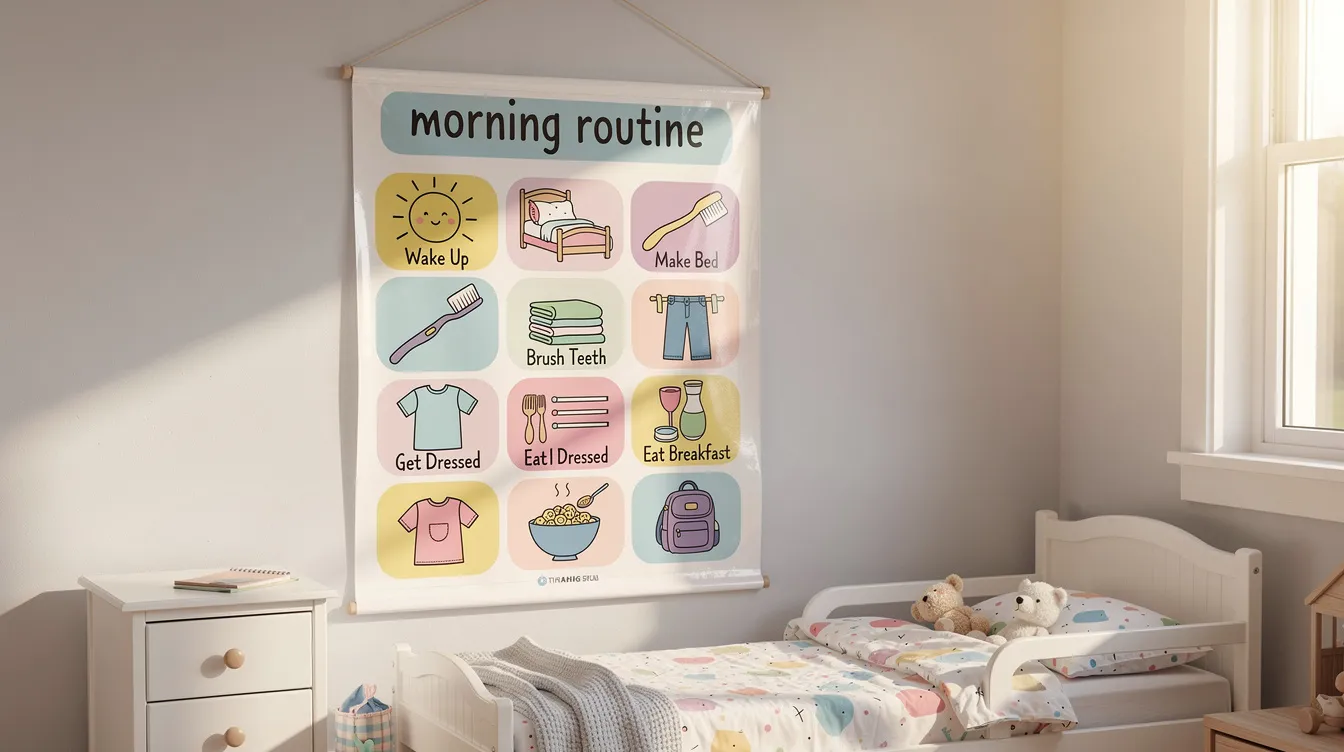
Create a basic visual checklist for the morning routine. Break “get ready for school by 8:15am” into seven clear steps:
- Wake up (7:00)
- Brush teeth (7:05)
- Get dressed (7:10)
- Eat breakfast (7:15)
- Pack school bag (7:45)
- Put on shoes (8:10)
- Out the door (8:15)
Parental reports in a 2022 survey of 1,500 families found this approach reduces morning chaos by 40–60%.
Use colour-coding for school subjects. Assign colours across notebooks, folders, and digital files—blue for English, green for science, red for math. Organizational psychology experiments show colour-coding enhances retrieval speed by 25%.
Set up a “launch pad” at home. Designate a single shelf or basket near the door where the school bag, sports kit, permission slips, and completed homework always live. Having a specific spot for completed homework helps build automatic organizational habits and ensures nothing is forgotten on the way out.
Establish a nightly 5–10 minute reset. The child checks tomorrow’s timetable, packs their bag, and ticks off an end-of-day checklist. This routine reduces next-day oversights by 40–50%.
Limiting daily focus to three key tasks helps maintain concentration and effectiveness. Encourage your child to pick the three most important tasks each evening so they wake up with clarity.
Creating a family calendar allows children to take responsibility for future events while personalizing it with doodles and stickers, making planning fun and engaging. Hang it somewhere visible—kitchen fridge, hallway—and update it together each week.
Using Visual Checklists and Schedules Effectively
Using visual scheduling tools can aid children in managing their time and tasks more effectively by making the steps visible. They work especially well for younger children and visual learners.
Choose the right format for the age:
| Age Group | Recommended Format |
|---|---|
| 5–7 years | Picture-based charts with Velcro icons |
| 8–11 years | Written lists with checkboxes |
| 12+ years | Digital to-do apps or bullet journals |
Co-create the checklist. Teaching children to use visual support tools, such as checklists and graphic organizers, can significantly improve their planning and organization skills, especially for those with communication difficulties. Let your child add their own drawings or choose icons. Ownership increases adherence by 35%.
Examples of daily checklists:
- Before school (7 items)
- After school (homework, snack, free time)
- Bedtime (brush teeth, lay out clothes, pack bag)
- Weekly backpack clean-out (sort, shred, file)
Using checklists and graphic organizers can help children navigate tasks more easily, providing a creative way to identify the steps needed to achieve a goal. Keep lists short—five to seven items maximum—and review them at a predictable time each day until the routine feels automatic.
Using visual aids, such as color-coded calendars and notes, can make information and deadlines more immediately recognizable. A colour-coded wall calendar paired with a daily checklist creates a powerful system.
Parents and educators can also access various resources, such as printable planners, online guides, or recommended games, to further support children in developing planning and organisation skills.
Teaching Children to Break Tasks Into Manageable Steps
Many students struggle because instructions like “finish your project” are too vague. Breaking tasks into manageable steps helps children understand what needs to be done without feeling overwhelmed.
Model the process with a real example. Take a history project due on 30 June:
| Step | Due Date | Estimated Time |
|---|---|---|
| Research topic | 15 June | 45 min |
| Create outline | 18 June | 30 min |
| Write first draft | 22 June | 60 min |
| Edit and revise | 26 June | 30 min |
| Final check and print | 29 June | 20 min |
Use a simple script: “What is the first small thing we could do?” This question shifts the child’s focus from the overwhelming whole to one manageable step.
Writing each step on separate lines and estimating duration connects planning skills with time management. Encourage daily practice on smaller tasks—packing a sports bag, organising a pencil case—so the skill becomes automatic before larger tasks arrive.
Having children plan an event, such as a family outing or sleepover, teaches them about responsibilities and the steps required to keep others entertained. Let them map out invitations, snacks, and activities.
Baking or cooking with children serves as a natural checklist, helping them improve their planning skills by following recipe steps and instructions. Next time you make cookies, hand over the recipe and let your child lead.
Making Time Visible: Building Time Management Skills
Time is abstract. Many children with executive function challenges have a difficult time sensing how long tasks actually take—a phenomenon researchers call “time blindness,” affecting up to 70% of those with ADHD.
Use visual timers. Sand timers, hourglass timers, or phone countdown apps show the passage of 5, 10, or 20 minutes during homework or household chores. A 2018 meta-analysis found visual timers raise focus by 40%.
Write start and finish times on a planner or whiteboard:
Math homework: Start 4:10pm – Finish 4:30pm
Teaching children to set realistic time goals for tasks can help them develop a better understanding of how long activities take, reducing feelings of overwhelm.
Introduce time-blocking for older students. Time-blocking involves dedicating specific blocks of time in your calendar for various activities, including breaks and deep work. A typical after-school schedule might look like:
- 4:00–4:30: Snack and free time
- 4:30–5:00: Math homework (focused block)
- 5:00–5:10: Break
- 5:10–5:40: English homework
Batching similar tasks, such as answering emails and making calls, reduces switching costs and enhances productivity. Teens can batch all writing assignments on one evening and all math on another.
Reflect weekly. Sit with your child for five minutes each Sunday to review how accurate their time estimates were. Gently adjust future plans as their sense of time improves.
Backward Planning From Real Deadlines
Backwards planning requires identifying a deadline and working backwards to determine the timeline for each step needed to meet that deadline. This skill is a game-changer for long tasks like essays, science projects, or exam revision.
Concrete example: English essay due 15 September.
| Step | Target Date |
|---|---|
| Final proofread | 14 Sept |
| Revise draft | 12 Sept |
| Write first draft | 8 Sept |
| Create outline | 5 Sept |
| Research and brainstorm | 2 Sept |
Sit beside the child with a calendar—paper or digital—and map out each step together, including buffer time for illness or unexpected events.
Revisit the plan mid-way. If the child fell behind due to a cold, adjust remaining dates. This teaches that planning is flexible, not rigid.
Practising backward planning with schoolwork prepares teens for future responsibilities like exams, job applications, and work projects. The habit transfers directly to adult life.
Creating Supportive Environments at Home and School
Systems and routines work best when the physical and emotional environment reinforces planning and organisation skills.
Set up a distraction-minimised study space:
- Essential supplies within reach
- A visible analog clock
- A simple checklist posted nearby
- Phone and toys out of sight
Regularly clearing physical and digital spaces, known as decluttering, can improve focus and minimize distractions. Schedule a weekly tidy of the study area.
Filing systems should be organized into consistent folders with clear naming conventions for easy retrieval of documents. Apply this to both physical binders and digital folders—subjects, date ranges, or project names.
Build predictable transitions. Establishing predictable morning and evening routines can help automate decisions and decrease anxiety. A child who unpacks their school bag immediately after arriving home and prepares clothes the night before faces fewer decisions in the morning.
Use positive prompts and praise for effort. Replace nagging (“You forgot again!”) with collaborative problem-solving (“What could we add to your checklist so this doesn’t slip?”). When organisation links to success rather than conflict, children engage more willingly.

Adjusting Expectations by Age and Stage
A five-year-old, a ten-year-old, and a sixteen-year-old will not have the same planning and organisation skills or responsibilities.
Younger children (ages 5–7):
- Work from simple picture routines
- Require close adult guidance for most steps
- Handle one or two tiny responsibilities at a time
Middle schoolers (ages 10–13):
- Maintain their own planner with adult check-ins a few times per week
- Take responsibility for packing their own bag and completing homework
- Begin using backward planning for projects
Older teens (ages 14–18):
- Manage complex workloads, extracurricular activities, and part-time jobs
- Use calendars, time blocks, and project plans independently
- Reflect on their own productivity and adjust systems
Gradually hand over responsibility. Move from packing the child’s bag for them, to checking a list they complete on their own, to trusting them entirely. This progression mirrors the development of executive skills from external scaffolding to full independence.
Maintaining Progress and Building Long-Term Habits
Planning and organisational skills develop through repetition, reflection, and small adjustments over months—not days. Research suggests habit formation takes 21–66 days of consistent practice.
Introduce one or two changes at a time. A new visual checklist this week. A nightly bag check next week. Overhauling everything at once leads to burnout.
Conduct weekly reviews. Conducting a weekly review can help keep track of your calendar, update to-do lists, and plan for the week ahead. Sit together for 10 minutes each Sunday:
- What went well?
- What was hard?
- Which tools helped most?
This reflection reinforces that these are skills the child is actively learning, not personality flaws.
Link skills to benefits the child cares about. More free time for games. Less last-minute stress. Celebrating completed tasks and milestones can reinforce positive organizational habits. A small reward—extra screen time, a favourite snack—after a week of consistent bag-packing can boost motivation.
Longitudinal data tracking over 1,000 individuals from birth to age 45 shows that strong planning and organisation skills correlate with 20–30% lower stress levels and 15% better time management in adulthood. The effort you invest now pays dividends for a lifetime.
Frequently Asked Questions
How early can I start teaching planning and organisation skills?
Elements of planning and organisational skills can start in preschool. Simple routines like putting toys back in labelled bins and following a short picture schedule build the foundations. More formal tools—written planners, backward planning from due dates—typically become effective from about age 8–9 onward. Match expectations to developmental level, focusing on one or two tiny, concrete responsibilities at a time.
What if my child resists using checklists or planners?
Involve your child in designing the tools. Let them choose colours, stickers, or a digital app that feels appealing. Start with very short, highly achievable lists—two or three items—that lead to immediate success. When they forget, use gentle, neutral follow-up questions like “What’s on your list next?” instead of nagging. Playing board and card games that require strategy can promote planning skills, as children must identify steps to achieve their goal of winning—a fun, low-pressure way to build the same muscles.
How do I support a child with ADHD or similar executive function challenges?
Children with ADHD often need stronger external supports—visual checklists, timers, frequent check-ins—and more repeated experiences to build planning and organisation skills. Keep work intervals short (15–20 minutes) with clear breaks, using visual timers and movement to maintain focus. Collaborate with teachers and, where relevant, health professionals to create consistent strategies between home and school. A 2022 MTA study found such consistency improves outcomes by 40%.
How can teachers fit planning and organisation teaching into a busy classroom schedule?
Build brief planning moments into existing routines. Start each lesson with a two-minute “plan your next three steps” prompt. Model task breakdown on the board at the beginning of assignments and leave the steps visible throughout the activity. Weekly classroom routines like “Friday backpack clean-out” or “end-of-lesson table reset” normalise organisation for all students without consuming extra time.
When should I consider seeking additional professional support?
If a child’s difficulties with planning and organisation skills are severe, persistent, and impacting wellbeing or academic progress despite three months of consistent support, extra help may be useful. School-based support staff, educational psychologists, or paediatric professionals can assess executive function skills using tools like the BRIEF-2 and suggest tailored strategies—such as Cogmed training, which has shown 25% gains in working memory. Seeking help is about giving the child more tools and understanding, not labelling them as lazy or incapable.
Comments are closed