
For many autistic children, a last-minute swap in class timetables, an unannounced fire drill, or a different teacher walking through the classroom door can feel like the ground has shifted beneath them. This article explores why routine changes hit so hard, and what parents and educators in Singapore can do to make transitions safer, calmer, and more manageable.
Key Takeaways
- Many autistic children experience intense anxiety or meltdowns when school or home routines change suddenly – relief teachers, exam timetable shifts, or last-minute CCA cancellations are common triggers in Singapore schools.
- This is about nervous system safety, not stubbornness or “bad behaviour.” Predictable routines can provide a sense of safety for autistic children, and disruptions in routine can lead to emotional distress or meltdowns.
- Visual schedules reduce anxiety by showing what to expect next, and social stories prepare children for new events effectively. These tools, combined with extra time and advance warnings, make changes far more manageable.
- Co-regulation – staying calm with your child – matters more in the moment than explanations or discipline, especially during a meltdown.
- Specialised learning intervention and professional support can help children build long-term transition skills and coping strategies that carry over between home and school.
When a “Small” Change Feels Huge: A Classroom Story
Nine-year-old Jin attends a primary school in Bishan. Every Monday morning follows the same pattern: assembly, then Maths with Ms Tan, then recess. One Monday, a relief teacher walks in instead of Ms Tan. Jin freezes at the classroom door, refuses to sit down, and eventually slides under a desk, silent and rigid.
His form teacher initially reads this as defiance. A classmate calls it “drama.” But Jin isn’t choosing this response – his nervous system has registered an unannounced change and interpreted it as danger.
What helped Jin was not a lecture or a consequence. It was this:
- A one-page visual schedule placed on his desk each morning, showing the day’s activities with pictures.
- A simple “Change Card” – a laminated card with a question mark – added to the schedule whenever something would be different.
- Advance warnings from his form teacher: “Tomorrow there will be a relief teacher for Maths. Your classroom stays the same.”
- A quiet corner with a beanbag where Jin could sit for five minutes before joining the new class.
What changed was the support, not the child. Visual schedules helped Jin anticipate upcoming changes. Co-regulating adults made his nervous system feel safer. Within weeks, Jin could manage transitions like timetable swaps and fire drills with noticeably less distress.
Why Routine Feels Like Safety for Autistic Children
Children with autism often rely on routines to make sense of their world. Think of routine as a mental “map” for the day. When that map changes without warning, the brain can interpret the mismatch as a threat.
Here is what happens at a neurological level, in parent-friendly terms:
- Autistic brains on the autism spectrum often depend more on explicit, visual prediction to navigate daily life. Research into predictive coding in autism shows that when reality suddenly diverges from what the child expected, the nervous system spikes anxiety and triggers fight, flight, or freeze responses.
- Sensory processing load – the noise of recess, fluorescent lights, a crowded MRT ride to school – already uses up significant cognitive resources. Adding an unexpected change on top can quickly feel overwhelming.
- Intense reactions to change – meltdowns, shutdowns, task refusal – are signs of overload, not manipulation. A neurodiversity-affirming stance respects the child’s own experience rather than labelling it as defiance.
A regulated brain learns. An overwhelmed brain survives. Predictability and regulation come first; learning follows.
Routines help reduce anxiety in children with autism spectrum disorder, and routine consistency improves behavior and builds independence in autistic children over time.
Common Routine Disruptions in Singapore School Life
Parents and teachers can scan this checklist to recognise common transition triggers:
Academic disruptions:
- Relief teachers replacing familiar form or subject teachers
- Last-minute classroom or venue changes (e.g., hall closed for PSLE preparation)
- Timetable shifts near exam periods, reworded exam formats, or sudden changes in group project partners
Environmental changes:
- Unannounced fire drills or lockdown drills
- National Day, Racial Harmony Day, or Teachers’ Day assemblies with loud music and different schedules
- Sports Day with unfamiliar timetables, venues, and crowd noise
Seasonal transitions:
- Moving from structured school terms into the open-ended June and December holidays, and back again
- Schedule shifts during Ramadan, Chinese New Year, or Deepavali periods
Home changes that compound school stress:
- A visitor staying over, a parent on an overseas work trip, a helper change, or a shifted bedtime
Even “small” home disruptions can layer onto school stress. Data from Singapore’s Ministry of Health shows the number of school-going children diagnosed with neurodevelopmental conditions in public hospitals rose from about 7,832 in 2021 to 9,114 in 2025 – meaning more families than ever are navigating these exact challenges.
Planned vs Unexpected Changes: Matching Supports to the Situation
Not all changes carry the same weight. Planned changes allow preparation; unexpected changes demand rapid coping.
For planned changes (e.g., a scheduled school excursion to the Science Centre, a known exam timetable):
- Use visual schedules and social stories over days or weeks in advance. Social stories can prepare children for specific upcoming events.
- Give the child extra time to ask questions and rehearse what will happen.
- Gradual changes help children process transitions comfortably – introduce one new element at a time rather than everything at once.
For unexpected changes (e.g., teacher on MC, sudden timetable swap, bus breakdown):
- Use a “Change Card” symbol on the visual schedule so the child can see that something is different.
- Offer a go-to phrase: “Today is different, but you are safe.”
- Timers can help children transition between activities smoothly when the usual schedule is disrupted.
- Offering choices during change reduces resistance in children – even small ones like “Do you want to sit here or there?” give a sense of control.
Maintaining anchor routines – the same snack, the same leaving-school sequence, the same bedtime story – can provide stability during chaotic days, even when everything else shifts.
We cannot remove all change from a child’s life. But we can make change predictable and supported.
Using Visual Schedules and Social Stories to Rebuild Predictability
Visual schedules are concrete tools that stay visible, unlike spoken instructions that vanish the moment they are said. They help children with autism predict upcoming events and manage transitions step by step.
Practical formats include:
- A simple 3-picture strip for the morning routine before school (get dressed → eat breakfast → pack bag)
- A full school-day visual schedule in the classroom using icons or photographs
- A weekly calendar for older autistic children, using apps or a laminated board
Signalling change visually:
- Add a “?” icon or “Change” card to the schedule when something will be different
- Use “First–Then” boards: “First surprise assembly, then quiet reading corner”
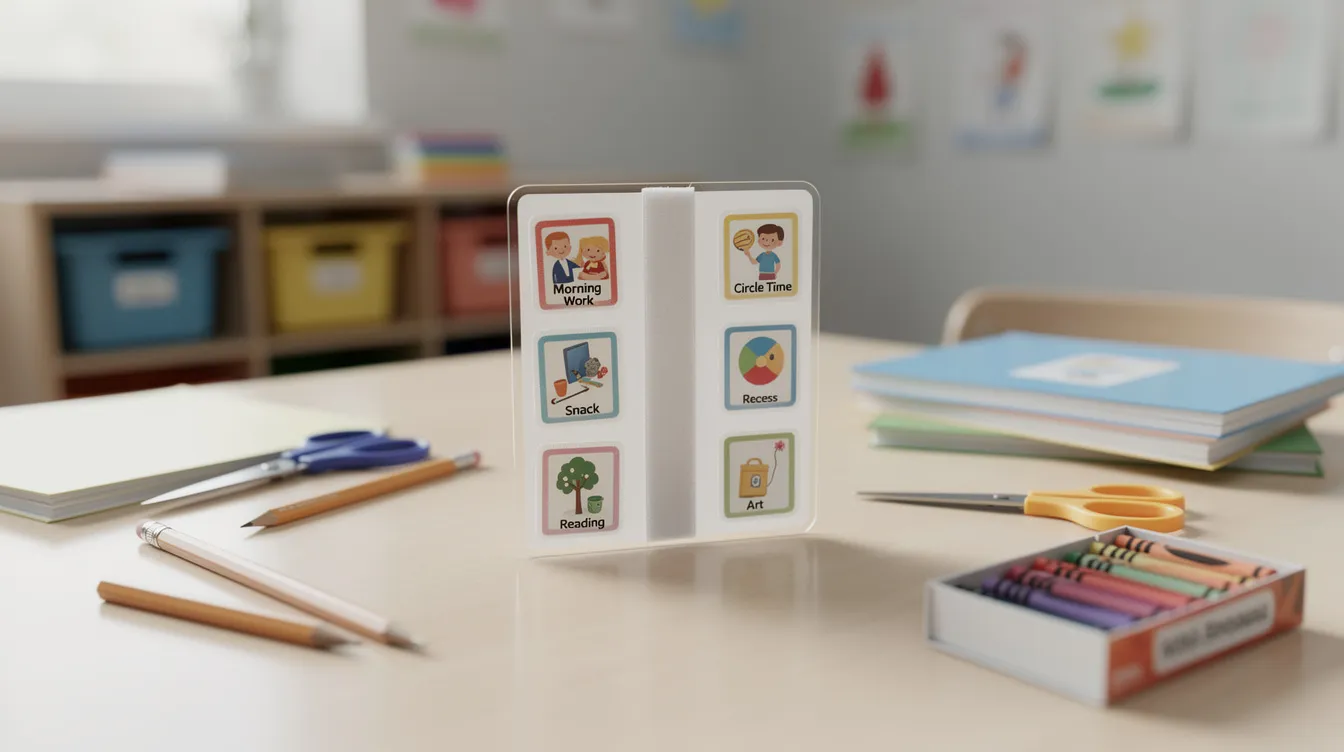
Social stories help children understand upcoming changes in a relatable way. These are short, personalised narratives explaining what will happen. For example:
“Sometimes my usual teacher is not at school. A different teacher called a relief teacher comes instead. The classroom looks the same. I can still sit at my desk. If I feel worried, I can use my help card.”
Where possible, use actual photos of the child’s classroom and school environment. Visual supports respect autistic communication strengths and can be adapted as the child grows. Research by Schneider and Goldstein (2010) found that combining social stories with visual schedules increased on-task behaviour effect sizes from d ≈ 1.33 to d ≈ 1.70 – a meaningful additive benefit.
Teaching Transition Skills and Coping Strategies Gently
Transition skills – the ability to move from one activity or place to another – can be taught gradually, not forced. Start with very small, low-stress changes at home or in the classroom.
Coping strategies to rehearse when calm:
- Deep breathing (e.g., “4-4-4 box breathing”: inhale 4 counts, hold 4, exhale 4)
- Squeezing a sensory toy or stress ball
- Using noise cancelling headphones during overwhelming moments
- Holding up a “help card” to ask for extra time without needing to speak
Building flexibility through play:
- Try “pretend changes” in a game format: “Today we pretend we sit at a different chair for snack.” Practicing transitions before they occur can increase comfort for autistic children.
- Use positive reinforcement: praise encourages children to adapt to unexpected changes. Name the skill specifically – “You coped with a different route to the hall. That was flexible.”
- Offering choices during changes gives children a sense of control and reduces frustration.
Providing sensory tools – fidgets, weighted lap pads, chewable items – can help children self-regulate during transitions. Creating safe sensory regulation spaces, even a small quiet space at home, gives the child somewhere to decompress.
Some children benefit from specialised communication and language support, especially if they struggle to ask for help or express anxiety verbally. Improving communication around needs is often as important as the coping strategy itself.
Track what helps – a quick journal or notes on your phone – and share these observations with school staff.

Supporting Your Child During a Transition Meltdown
Meltdowns or shutdowns during routine changes are involuntary nervous system responses, not “tantrums for attention.” Parents and educators should validate children’s emotions regarding changes rather than dismissing or punishing them.
Transition De-escalation Steps:
| Step | What to Do |
|---|---|
| 1. Safety first | Move the child away from hazards. Clear the immediate environment if possible. |
| 2. Reduce sensory load | Lower lights, reduce noise, move to a quieter space. Offer noise cancelling headphones or a preferred sensory item. |
| 3. Lower demands | Stop asking questions or giving instructions. This is not the moment for logic or lectures. |
| 4. Use few calm words | “I’m here. You are safe. This is really different.” Model slow breathing and a calm voice. |
| 5. Allow recovery time | Give the child as long as they need. Do not rush re-entry into the classroom or activity. |
Emphasise co-regulation: adults model the calm they want the child to feel. Supporting children with autism through changes requires clear communication – but only after the child’s nervous system has settled.
After the meltdown:
- Debrief briefly only when the child is fully regulated. Keep it short: “That was hard. The change was unexpected.”
- Adjust supports for next time – add a visual schedule step, give an earlier warning, or identify a preferred activity the child can access afterwards.
- Avoid shaming language. Never say “You should have tried harder” or “Everyone else managed fine.”
Why “Just Try Harder” and Typical Tuition Don’t Fix Transition Stress
Conventional academic coaching or standard tuition in Singapore often focuses on drills, speed, and compliance. When an autistic child struggles during a routine change, the behaviour is frequently misinterpreted as laziness, disrespect, or an “attitude problem.”
This leads to punishment, lost privileges, or lectures – which increase anxiety, deepen emotional distress, and can trigger school refusal and learning stress.
For many children with autism, the core difficulty is not motivation. It is executive functioning – cognitive flexibility, shifting attention, working memory, and planning. A meta-analysis of 235 studies found moderate effect sizes (Hedges’ g ≈ 0.48–0.60) for executive function differences in children and adolescents with autism spectrum disorder. Children with co-occurring ADHD often show even more pronounced challenges.
While ABA therapy focuses on building transition skills for children with autism, Cognitive Development Learning Centre takes a different approach – understanding the autistic learning profile and adapting the environment and expectations, rather than focusing on behavioural compliance alone.
Look beyond grades and behaviour charts. Safety, regulation, and relationship are the foundations for learning.
How Specialised Learning Intervention Can Help Your Child Manage Transitions
A comprehensive cognitive assessment can reveal specific strengths and challenges in areas like working memory, processing speed, and cognitive flexibility. This gives families and schools a clear picture rather than guesswork.
From there, individualised programmes can be built:
- Structured routines with gradual change exposure and tailored coping strategies
- Simulated real-life school scenarios – sudden worksheet changes, a different teacher, timetable shifts – practised in a safe, low-pressure environment
- Collaboration with schools and families to create consistent strategies: visual schedules, communication systems, and classroom accommodations appropriate for Singapore mainstream and special educational needs settings
Professional support can help children manage transitions effectively, and professional guidance can reduce frustration during transitions for families navigating these challenges daily. Gradual implementation of changes within a supportive environment can reduce anxiety for autistic children over time.
Longitudinal research shows that executive function in autistic children does improve with intervention – a 2024 meta-analysis confirmed that progress is possible when children receive the right support early.
When to Seek Additional Professional Support
Look for these signs that extra help may be needed:
- Frequent school refusal linked to minor routine changes
- Daily meltdowns around transitions (not just occasional difficult days)
- Regression in skills after school holidays
- Panic or extreme avoidance around exam timetables, assemblies, or new teachers
When home and school strategies are not enough, parents can explore child psychological therapy for school stress as an option for children overwhelmed by transitions.
Coordinated care – where parents, teachers, psychologists, and learning specialists share a plan with shared language around change – produces the best outcomes. Seeking help is not a failure. It is a proactive step to protect your child’s mental health and long-term relationship with learning.
Partnering with Cognitive Development Learning Centre in Singapore
Cognitive Development Learning Centre focuses on sensory, executive, and emotional regulation needs in neurodivergent learners – not behaviour compliance, not standard drill tuition.
Typical supports include:
- 1-to-1 learning intervention tailored to each child’s profile
- Transition skills coaching and customised visual schedule systems
- Collaboration with teachers on classroom accommodations
- Assessment to identify the specific executive functioning barriers behind transition difficulties
If your child struggles with relief teachers, exam timetable shifts, CCA changes, or school holiday transitions, book a consultation to discuss assessment or intervention options.
With the right predictability, visual supports, and emotional safety, autistic children can navigate change with much more confidence. The goal is never to eliminate change from daily life – it is to make your child feel prepared, supported, and safe enough to learn.

Frequently Asked Questions
How do I explain an unexpected change to my autistic child on the way to school?
Use one short, honest sentence: “Today your teacher is absent and there will be a relief teacher, but your classroom stays the same.” Pair words with a quick visual on a small card or phone image – a picture of a different adult with the word “Change.” Offer a simple coping choice: a favourite fidget, arriving early to settle, or a quick moment in a quiet space before class. Repeating the same calm script helps the child feel safer, even if they still look upset. Visual aids like a phone photo of the school can help the child process faster than words alone. A doctor’s appointment, a different route to school, or a preschool drop-off change can all use this same approach.
What if school won’t allow a full visual schedule on the wall?
Propose portable alternatives: a small laminated visual schedule on a ring, a “First–Then” card on the desk, or a visual schedule in a notebook or tablet app in the student’s browser. Frame visual strategies as support for attention and independence, not “special treatment,” when speaking with teachers. Even small, consistent visual supports can significantly help children with autism manage transitions. Negotiate at least one predictable visual element rather than taking an all-or-nothing approach.
How can I support my child with transitions during long school holidays?
Keep a simple daily visual schedule at home – wake-up, meals, play, screen time, outings, bedtime – to replace the lost school structure. Plan “transition practice days” before term starts: visiting the school gate, walking the route, or reviewing photos of the classroom. Keep some anchors from daily routines (consistent wake-up time, similar morning sequence) to smooth the shift back. Holidays are a good time to build coping strategies and practise flexible play in a low-pressure setting – families can create opportunities for the child to learn at their own pace.
Is it okay to use rewards when my child copes well with change?
Celebrating flexible moments can help, but rewards should feel encouraging, not controlling. Focus on naming the skill: “You coped with a different bus today – that was flexible and brave.” A favorite activity or extra reading time together works well as positive reinforcement. Avoid withdrawing rewards when the child is overwhelmed, as this increases shame. Instead, adjust the level of support next time. The goal is to help your child feel more confidence through encouragement, not to create performance pressure.
What if my child’s school thinks the behaviour is just defiance?
Share brief written examples of patterns – meltdowns only when timetable changes, assemblies, or relief teachers appear – to show the link with transitions rather than general defiance. Request a meeting with the form teacher and special educational needs coordinator to discuss visual schedules, extra time warnings, and access to quiet spaces. Bring any cognitive assessment or therapist reports that explain your child’s autism-related learning difficulties to advocate for accommodations. If the situation remains unresolved and your child’s stress is high, seeking external guidance from Cognitive Development Learning Centre can help you create a plan and navigate next steps with the school.
Comments are closed