Supporting Children with Other Learning Difficulties
Helping children who struggle in school despite their effort, from primary through secondary school.

Other Learning Difficulties That Affect Children’s Learning
Understanding Hidden Learning Challenges
Some children struggle in school in ways that are hard to explain. They may work hard, attend tuition, and spend long hours revising, yet continue to fall behind or show inconsistent results. These challenges can emerge in primary school and intensify in secondary school, even without a formal diagnosis. At Cognitive, we support children with other learning difficulties that affect learning from primary through secondary school.

What Other Learning Difficulties Often Look Like in School
Some children lack the skills required to cope with certain subjects, while others have mild or atypical learning difficulties that do not fall into commonly recognised categories. This includes children with conditions such as Dyscalculia or Dyspraxia, where support options may be limited.
These challenges often result in inconsistent performance, difficulty retaining learning, and growing frustration.
Inconsistent Performance
Results vary unpredictably across subjects and assessments
Difficulty Retaining Learning
Struggles to remember and apply what has been taught
Growing Frustration
Increasing stress despite continued effort and practice
Why Tuition and Waiting Often Do Not Resolve These Difficulties
Tuition focuses on reinforcing content, which may not address underlying learning challenges. Waiting for children to ‘catch up’ can allow difficulties to accumulate. Without targeted learning skills development, increased practice often leads to fatigue rather than progress.

How Learning Intervention Supports These Children
Learning intervention focuses on how a child learns. Support is customised to strengthen foundational learning skills, improve application of strategies, and help children cope with increasing academic demands in a structured, supportive way.
Learning intervention supports children by addressing key areas that affect how they learn.
Strengthen Foundational Learning Skills
Build the core abilities needed for effective learning
Improve Application of Strategies
Develop practical approaches that work for each child
Cope with Increasing Academic Demands
Provide structured support as school requirements intensify

Who This Support Is Suitable For
This support is suitable for children from primary through secondary school who struggle despite effort, show uneven performance, or have less common learning difficulties.
Primary School Children
Early identification and support to build strong foundations
Secondary School Students
Targeted intervention as academic demands increase
Less Common Learning Difficulties
Support for Dyscalculia, Dyspraxia, and atypical challenges
Children Who Struggle Despite Effort
For those working hard but not seeing results
How This Fits Within the Learning Intervention Pathway
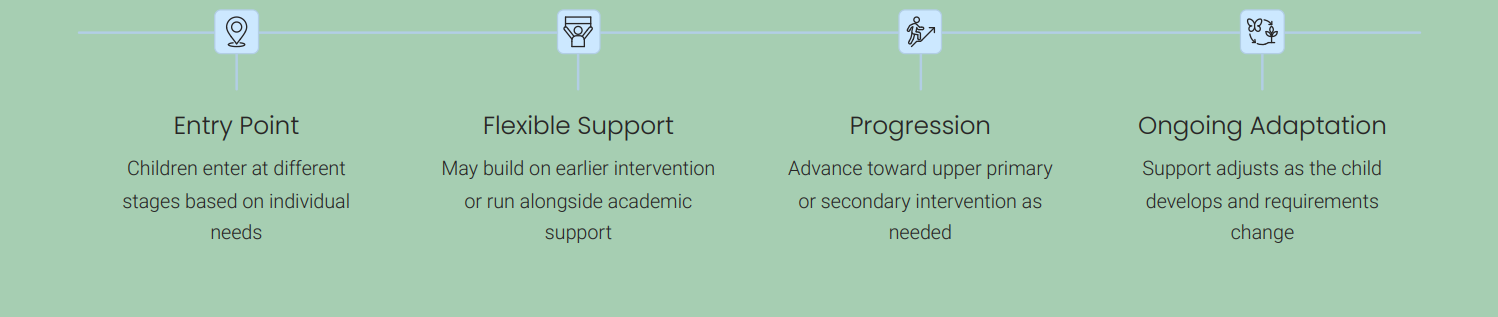
Children may enter learning intervention at different stages. Support is flexible and may build on earlier intervention, run alongside academic support, or progress toward upper primary or secondary intervention.

Progress and Outcomes
Parents often notice meaningful changes that were not seen with tuition alone. These include improved understanding, greater independence, and reduced frustration. Progress is reviewed and adjusted as the child develops.
Improved Understanding
Children grasp concepts more deeply and retain learning better
Greater Independence
Students develop confidence to tackle challenges on their own
Reduced Frustration
Learning becomes less stressful for both child and family
Related Difficulties
Next Steps
An initial consultation may help explore possible learning challenges and discuss how learning intervention may help. Clearer understanding often emerges over time as we work with the child and observe learning patterns.
Ready to Start?
Book a consultation to discuss your child’s specific needs and how we can help.