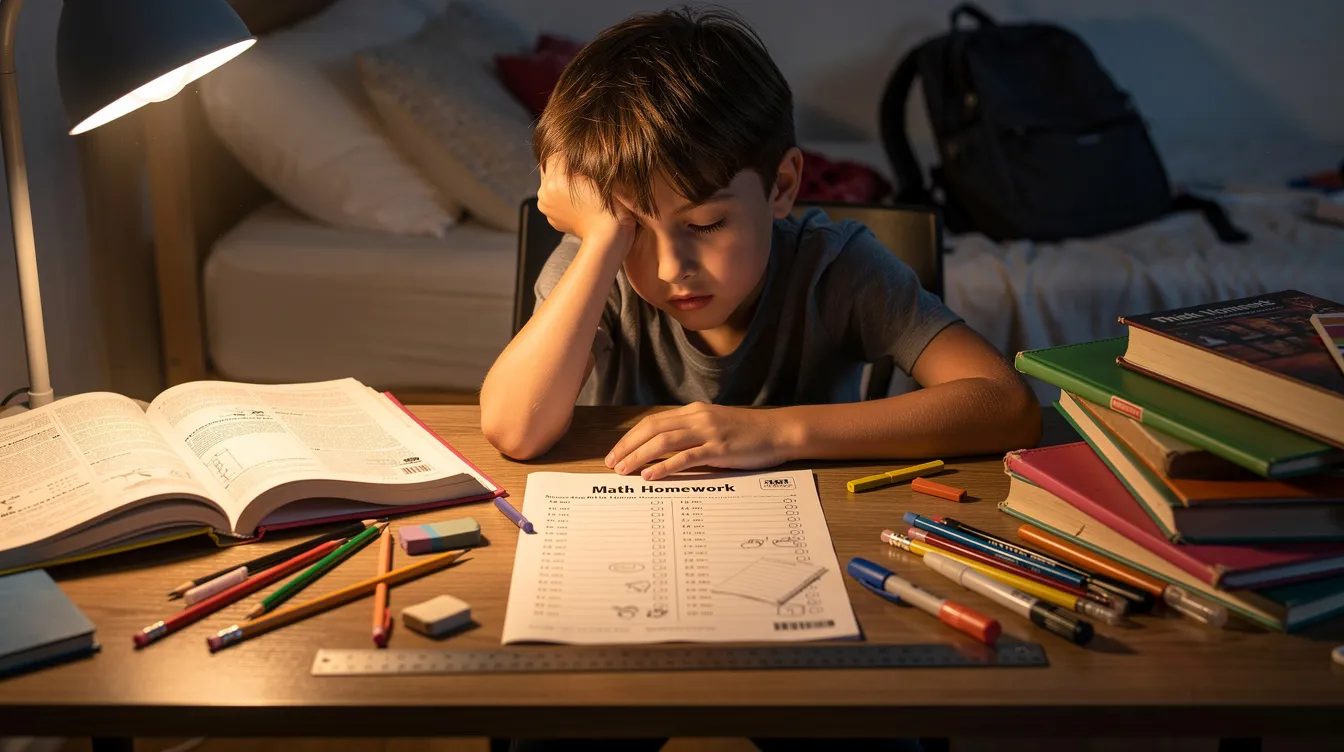
It is 7.45 pm on a Tuesday in Singapore. A Primary 4 child has been sitting at the dining table since 4.30 pm, and the Maths worksheet – ten questions, supposedly twenty minutes of work – is still on Question 3. The eraser shavings are piling up. The pencil has been sharpened three times. You have said “Can you please just finish?” more times than you can count. Sound familiar?
If this scene plays out in your home most weeknights, you are not alone, and your child is almost certainly not being lazy. Here is what is really going on, and what you can do about it.
Key Takeaways
- A “20-minute” worksheet stretching into 2 hours is rarely caused by laziness. It is usually linked to bottlenecks in processing speed, working memory, and executive functions like planning, initiation, and impulse control.
- Simply adding more tuition, more drilling, or longer homework blocks often backfires – increasing anxiety, tears, and homework avoidance instead of building independence.
- When we adjust expectations, reduce cognitive load, and support executive function, homework time can become shorter, calmer, and more productive.
- These patterns are extremely common among Singapore primary and secondary students, especially as workload ramps up in P4–P6 and Sec 1–2.
- With the right support – consistent routines, practical strategies at home, and specialised learning intervention when needed – most children can move from nightly meltdowns to more independent, confident homework habits.
The Nightly Homework Marathon: Why a 20-Minute Task Becomes 2 Hours
Picture this: a Primary 5 child reaches home at 3.30 pm after school and CCA, already having spent nearly seven hours in sustained mental effort. On the table tonight: English composition corrections, a P5 Maths heuristic worksheet, Science open-ended questions, and weekly Chinese spelling – all before a 9.00 pm bedtime. Mental exhaustion can occur before the child even opens the first book.
Many parents observe the same things: staring at a blank page, sharpening pencils repeatedly, making frequent toilet or snack trips, or spending fifteen minutes on a single short-answer question. Procrastination leads to fragmented work time and increased anxiety, making each task feel even harder.
From the outside this looks like a “don’t care” attitude. From the inside, the child often feels overwhelmed, anxious, and mentally stuck. Repeated prompting – “Hurry up!”, “Stop daydreaming!” – can unintentionally increase shame, which further slows thinking and problem solving. The pattern is especially visible in upper-primary and lower-secondary students, where workload and cognitive demands increase faster than the child’s brain can keep up.
What Is Really Going On: Cognitive Bottlenecks Behind Slow Homework
Think of the brain as a delivery system. Content knowledge is the package; processing speed, working memory, and executive control form the delivery van, the route, and the driver. If the system is overloaded, output slows down – even if the child is trying hard. Cognitive overload can disrupt attention and short-term memory, making a 20-minute task balloon into something much longer.
Three bottlenecks explain why homework takes so long for most struggling children:
- Processing speed – how fast the brain takes in information, makes sense of it, and produces a response.
- Working memory – the mental “work desk” that holds information while the child thinks.
- Executive functions – the brain’s management system for planning, starting, staying on track, shifting, and self-monitoring.
When any of these are weak, a child may look oppositional or careless, when in reality they are hitting a genuine cognitive limit.
Processing Speed: When the Brain Works Hard but Slowly
A child with slower processing speed may read a P4 English comprehension passage very slowly, re-reading sentences multiple times, taking far longer than classmates to finish the same worksheet. Research shows that in one cross-school study, “slow” students took two to three times as long as “quick” students to complete identical homework – not because they understood less, but because their brain works at a different pace.
Slow processing affects:
- Reading speed and decoding words
- Understanding the question
- Thinking through solutions
- Writing or typing responses
Consider a 10-year-old taking 40 minutes just to read and underline key words for four Science questions, leaving very little time and energy to actually write answers. Mental fatigue can lead to cognitive overload during these tasks, causing the child to stall further.
Processing speed is not about intelligence. Many bright kids in Singapore have strong reasoning but need longer to get ideas out on paper. A person’s ability to think deeply and a person’s output speed are separate things. Comments like “You are so slow” damage self-confidence and make the child dread homework and exams, worsening real life performance over the long term.
Working Memory: Losing the Thread Mid-Question
Working memory is the brain’s ability to hold and manipulate information over short periods. When it is limited, a child forgets the beginning of a sentence by the time they reach the end, or loses track of multi-step instructions like “Finish Question 2(b), label the diagram, then check your units.” Confusing instructions can lead to task avoidance, especially when a child simply cannot hold all the steps in mind.
A P3 Science example makes sense here: for a 3-part open-ended question, the child answers part (a) correctly, but by part (c) has forgotten what the experiment was about and writes off-topic answers. Research on algebra tasks found that most errors were attributable to working memory failure rather than lack of rule knowledge.
Common signs at home include:
- Constantly asking “What am I supposed to do again?”
- Copying the wrong question numbers
- Skipping steps in long-division or model-drawing
Cognitive overload can cause frequent memory lapses that look like carelessness. Working memory challenges are closely associated with executive dysfunction, meaning the difficulty often does not exist in isolation. Supporting memory typically requires strategy teaching – chunking, writing steps down – and sometimes structured learning intervention rather than more content drilling.
Executive Function: The Hidden Reason Starting and Finishing Are So Hard
Executive functioning is the set of skills that allow a child to plan, start, persist, shift between questions, and complete tasks. It includes inhibitory control (resisting distractions), cognitive flexibility (switching approaches when stuck), planning, and self-monitoring. Executive dysfunction affects emotional regulation and task management, making homework a daily battle.
Common signs of executive function deficits during homework:
- Taking 30–40 minutes just to start after sitting at the desk
- Jumping between questions without finishing one task before starting another
- Having trouble planning how long assignments will take (poor time management is a hallmark symptom)
- Leaving work half-done when a problem feels “too hard”
Many teens struggle to break tasks into manageable steps, and even primary school children face the same challenge. Impulse control – the ability to resist the phone notification, the younger sibling, or the YouTube tab – plays a central role. Without inhibition control, the child’s focus fragments and homework drags on.
When executive functions are weak – often seen alongside ADHD, autism, and other learning profiles – the struggle is not about content knowledge. The “brain manager” is simply overwhelmed. Executive dysfunction can lead to procrastination and low motivation, which parents frequently misread as laziness.
Task Anxiety and Perfectionism: When Fear Freezes the Pencil
Some children take a long time not because they have trouble focusing, but because they feel intense anxiety about making mistakes. Teens often avoid tasks due to feeling overwhelmed, and task avoidance can stem from fear of failure – even in primary school students facing English compositions, Chinese 作文, or open-ended Science questions.
Real life scenarios parents in Singapore will recognise:
- A Sec 1 student rewriting the same sentence five times, erasing repeatedly, still stuck on the first paragraph
- A P5 child insisting they “don’t know how” to answer a heuristics question, even after the method has been explained
Perfectionism delays completion of assignments by focusing excessively on minor details. If the child cannot see a “perfect” answer, they cannot write anything at all, leading to long delays and eventual tears. Stress and anxiety contribute to cognitive overload effects, consuming the mental bandwidth that should be used for creative problem solving and flexible thinking. Tasks inherently take longer when the brain is running on fear.
Watch for patterns: fast with simple MCQ, extremely slow with open-ended or creative tasks. That gap is a clue that anxiety – not understanding – is the main barrier.

Why More Tuition and More Drilling Often Make Things Worse
Many parents understandably respond to slow homework by adding tuition, extra papers, and weekend drilling. If the child completes work slowly, the instinct is to push harder with more practice. But when the true problem is slow processing, weak executive function, or working memory limits, more content simply adds to cognitive fatigue and emotional burnout. Understanding knowledge gaps matters, but piling on content without addressing the delivery system rarely fixes efficiency.
Before signing up for yet another tuition class, it is crucial to understand the difference between learning difficulties and laziness. A child who is genuinely struggling cognitively will not speed up because they receive more of the same content. Standard tuition focuses on re-teaching problem sums or comprehension passages without explicitly strengthening processing speed, inhibition control, or task initiation habits.
This is exactly why tuition doesn’t help some children. Without addressing the underlying cognitive system, time and money are spent with little long-term change in homework efficiency. Adults – parents and tutors alike – end up frustrated, and the child’s mental exhaustion deepens.
Real-Life Patterns Parents in Singapore Commonly See
These patterns happen across families and school types:
- “Fast in class, slow at home.” The child completes schoolwork quickly in a structured classroom but needs step-by-step prompting at home. Different routines, distractions, and parent-child emotional dynamics change the environment enough to disrupt executive control.
- “Exam-okay, homework-nightmare.” The child can perform during timed tests but unravels when facing a pile of different subjects each evening. This reveals executive overload rather than pure content gaps – misjudging task complexity causes unrealistic planning and rushed or stalled work.
- “Starts strong, fades by 8.30 pm.” Processing speed and decision making decline sharply at night, leading to careless errors and emotional outbursts. The brain’s stamina is finite.
These patterns link directly back to executive functions, cognitive stamina, and mental energy. Behaviour can look inconsistent across the day yet follow a clear brain-based pattern.
Keep a simple 1-week log of start times, subjects, and meltdown points. This data is invaluable when speaking with teachers, a healthcare provider, or a specialist who understands executive dysfunction. Early recognition in Primary 2–4 often allows gentler adjustments before PSLE pressure peaks.
Practical Strategies to Make Homework Shorter and Calmer
The goal is not to turn home into another tuition centre but to reduce cognitive overload by simplifying, structuring, and pacing demands. Multitasking is a common cause of cognitive overload – so start by ensuring the child works on one task at a time.
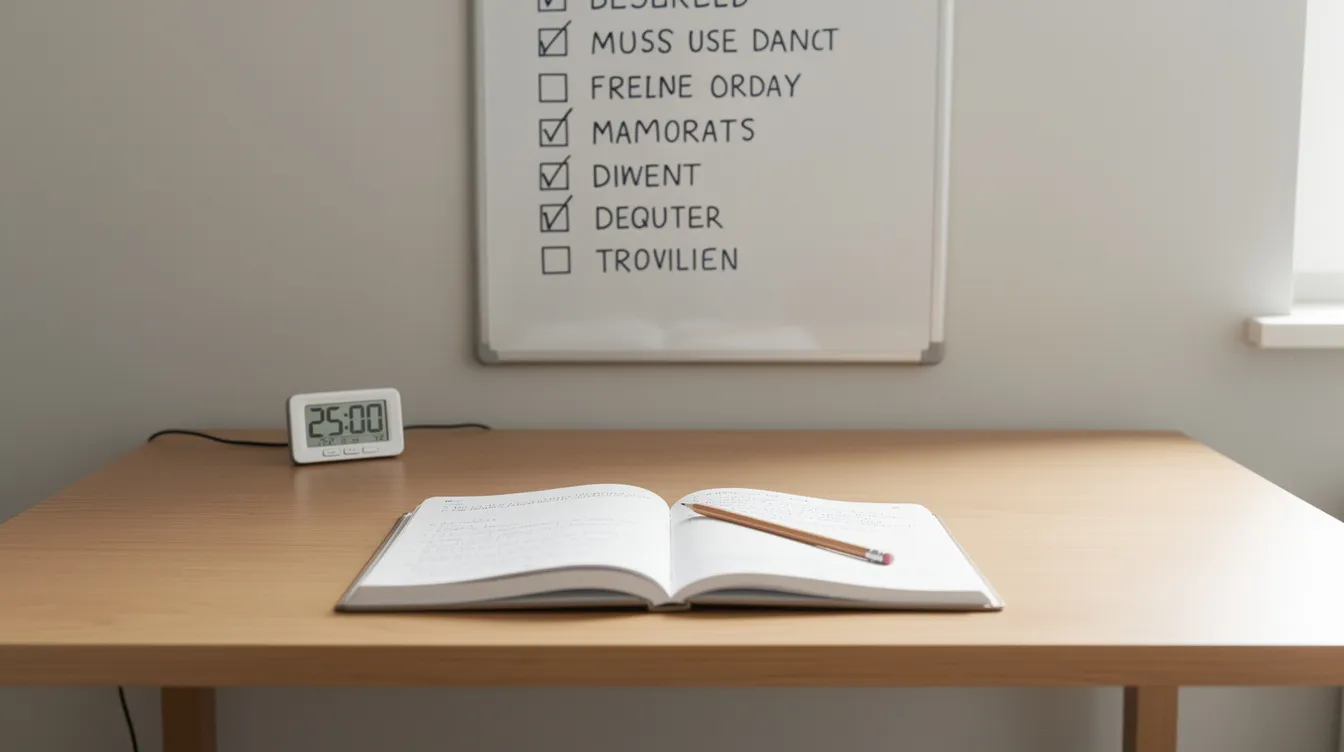
Timed cognitive sprints. The Pomodoro Technique enhances focus and prevents burnout by scheduling breaks. Use 10–15 minute focus blocks with a visible timer, followed by 3–5 minutes of movement – stretching, water, a short walk. This resets attention and impulse control.
Externalise executive load. Poor organization wastes time searching for materials during study sessions. Instead:
- Write a mini checklist for each evening (e.g., 1. Math Q1–5, 2. Science corrections, 3. Learn spelling)
- Use sticky notes or a whiteboard to show the sequence, rather than holding it all in working memory
Low-distraction workspace. Creating a dedicated, clutter-free workspace can motivate effective study habits. Environmental factors such as noise and interruptions hinder effective study, and digital distractions prolong study sessions by breaking concentration. Keep phones, TV, and unrelated toys out of sight. Noise-reducing headphones help in noisy HDB environments.
For children who need targeted support to strengthen underlying attention, working memory, and initiation skills – beyond just homework help – focus and attention support addresses learning readiness rather than syllabus content alone.
Supporting Executive Functions: Building Routines That Do the Heavy Lifting
Establishing a consistent study routine helps build positive study habits. For children with executive function challenges, strong routines act like training wheels – reducing decision making and lowering the entry barrier to starting homework.
A sample weekday structure:
| Time | Activity |
|---|---|
| 3.30–4.00 pm | Rest, snack, free play |
| 4.00–4.15 pm | Planning check-in with parent: list tasks, estimate durations |
| 4.15–5.30 pm | 2–3 focus blocks with breaks |
| 5.30 pm onwards | Consistent cut-off; remaining work flagged for teacher discussion |
Estimating task duration and comparing it with actual time taken aids in better planning – this skill develops with practice. Active learning techniques (like self-testing or summarising aloud) improve retention and understanding, reducing time spent re-reading.
Target specific executive skills:
- Inhibition control: practise ignoring WhatsApp alerts or a sibling’s noise during a 10-minute block
- Cognitive flexibility: rotate subjects (Math → English → Science) and coach smooth transitions
For structured, process-driven support that directly trains executive function and independent learning habits, a learning intervention typically focuses on the “how” of learning, not just the “what” of school content.
Celebrate small wins – starting within 5 minutes of sitting down, completing one full block without nagging. These are evidence that executive systems are developing over time.
When to Seek Professional Help for Slow Homework and Executive Dysfunction
Red flags suggesting that slow homework may be part of a broader learning or attention profile:
- Homework consistently takes more than 2–3 hours in upper primary despite reasonable effort
- Teachers report inattention, incomplete work, or daydreaming in class
- Strong verbal reasoning but extremely weak written output
- Meltdowns, stomach aches, or headaches appear predictably around homework time
- Medical conditions or a family medical history of ADHD or learning difficulties
Executive dysfunction is linked to ADHD and other mental health conditions, including anxiety and sleep disorders. Assessment by a psychologist, educational therapist, or healthcare provider can clarify whether ADHD, specific learning difficulties like dyslexia, or anxiety are contributing – including ruling out brain injuries or other medical causes.
Seeking help early when stuck can save time and improve understanding. An assessment is not about labelling; it is about mapping root causes so that support is accurately targeted. Regular sleep and hydration are also essential for maintaining focus and processing speed – sometimes simple lifestyle adjustments make a measurable difference alongside a balanced diet and consistent rest.
Bring concrete examples to any professional consultation: photos of homework, timing logs, teacher comments. These illustrate the daily life challenges far more clearly than a general description.
Conclusion: Restoring Peace to the Evening Routine
Slow, stressful homework is usually a symptom of underlying cognitive overload – not a character flaw. When families address processing speed, working memory, and executive functions directly, homework time shrinks and conflict drops. Research confirms that the right support, consistently applied, produces meaningful outcomes across school and life.
Your role can shift from “homework police” to learning coach: someone who helps structure routines, reduce distractions, and model healthy habits like breaks and realistic planning. With consistent practice and, where appropriate, specialised therapy or intervention, many children move from nightly meltdowns to more independent habits within months. Development of these skills is a long-term investment that pays off well beyond primary school.
Protecting the parent-child relationship matters more than completing every last optional worksheet. Long-term resilience grows when children feel understood rather than judged. If persistent slow homework, executive dysfunction, or emotional distress continue despite your best efforts, consider a professional consultation to map out a personalised, sustainable plan.

Frequently Asked Questions
Is my child just being lazy if homework always drags on?
While low motivation can play a role, chronic slow homework is far more often linked to slow processing speed, weak executive function, or anxiety. Try this simple test: sit beside your child for one full worksheet and quietly observe. If they are genuinely trying yet still move slowly or get stuck, laziness is unlikely the main issue. Speak with teachers to check if similar patterns appear in class – that validation confirms the difficulty is real. Many families discover the struggle is cognitive, not motivational.
How long should primary school homework reasonably take each day?
General guidelines (not strict rules): for Primary 1–3, around 30–60 minutes; for Primary 4–6, around 60–90 minutes on typical weekdays, with some variation near exams. If your child consistently takes 2–3 hours nightly despite working steadily, it is time to review workload, efficiency, and possible cognitive bottlenecks. Discuss with teachers if assigned homework regularly exceeds these ranges. Remember that sleep, play, and family time are also essential for healthy brain development and learning.
Should I sit next to my child for the whole homework time?
Constant supervision can help a stuck child in the short term but may reduce independence if maintained too long. A gradual approach works best: initially sit nearby during short focus blocks to coach routines, then over weeks step back to check-ins at the start and end of each block. The aim is to transfer responsibility to the child’s own executive functions, putting tools like visual checklists and timers in place of continuous verbal reminders. If a child cannot manage at all without a parent beside them after several months, a deeper assessment of attention and executive function may be warranted.
Can improving executive functions really change exam performance?
Stronger executive skills – planning, time management, inhibition control, cognitive flexibility – help children read questions carefully, allocate time across sections, and recover after getting stuck. A P6 student who used to spend 20 minutes on one PSLE Maths question can learn to move on after 3–4 minutes and return later, preserving marks across the whole paper. Content knowledge remains important, but many students already know enough; it is their task management and decision making under time pressure that limit scores.
How do I know if my child needs an assessment for ADHD or a learning difficulty?
Key indicators include persistent inattention or impulsivity across settings (home and school), big gaps between verbal ability and written output, and ongoing struggles with reading, spelling, or basic number concepts despite regular practice. Start with a conversation with the form teacher or school counsellor. If concerns remain, seek a formal assessment with a psychologist or paediatrician familiar with ADHD, dyslexia, and related conditions. An assessment does not commit your family to medication – it simply provides clarity so that strategies and support can be matched accurately to your child’s needs.
Comments are closed