
Key Takeaways
- Disorganisation in schoolwork is almost always rooted in developing executive functioning, not laziness or a lack of motivation. The prefrontal cortex-responsible for planning, working memory, and impulse control-is still maturing throughout childhood and adolescence.
- Three cognitive drivers create most of the chaos: weak executive function and categorisation gaps, working memory overload, and sequential processing or line-tracking failures. These interact to produce messy layout, lost materials, and missed deadlines.
- Adding more tuition or practice papers rarely solves the problem because content-driven instruction does not retrain how the brain plans, sequences, and monitors output.
- Organisation is a skill that can be taught through practice and supportive guidance. Process-based intervention, visual aids, checklists, and structured routines gradually shift children from dependence to confident independence.
Introduction: The Disorganisation Dilemma in Singapore Classrooms
Picture a typical weekday evening: a P5 child empties an overstuffed school bag onto the dining table. Out tumble crumpled Maths worksheets from Term 1, loose Science notes from P4, an unsigned spelling test, and exercise books with pages skipped. A consent form for Friday’s learning journey is nowhere to be found. The English composition draft has no paragraph spacing. Panic sets in-the SA revision schedule starts tomorrow.
Most parents see this scene and assume their child is careless or unmotivated. But learning to organize schoolwork is not a simple physical chore. It is a complex mental operation: planning which materials needed for each assignment should be brought out, prioritising tasks across subjects, sequencing steps within each assignment, and monitoring output-all while managing homework, tuition schedules, and CCA commitments. Many children who look “bo chap” are actually experiencing gaps in executive functioning and working memory that make this coordination genuinely difficult. This article, written from the perspective of a clinical educational psychologist and parent consultant in Singapore, unpacks the brain processes behind the chaos-and what families can do about it.
The 3 Underlying Cognitive Drivers of Disorganised Work
Why children struggle to organise their work usually comes down to three neurocognitive bottlenecks acting together. Executive functioning skills include working memory, cognitive flexibility, and inhibitory control, and all three are still developing well into adolescence. Research from NIE-NTU shows that among 6- to 10-year-olds, inhibition and flexibility are not yet clearly differentiated, which means the brain’s ability to break a large task into steps, categorise papers, or shift between subjects is still fragile.
Weak Executive Function and Categorisation Gaps
Children with lagging executive functioning skills struggle to stay organized because their brain cannot efficiently break a project like “revise for SA2” into smaller sub-tasks or group worksheets by subject and term. In class, this surfaces as messy long-division layout, Science notes scattered across multiple books, or a composition started without any planning.
Working Memory Overload in Complex Tasks
During a P5 Science open-ended question, a child must recall content, apply the C-E-R structure, maintain grammar, and track marks allocation. That leaves almost no mental capacity to label diagrams or write in organised paragraphs. A 2024 study of 309 school-age children found that working memory deficits (effect size d = −0.95 to −0.26) and organisational-skills deficits together explained virtually the entire academic achievement gap between children with and without ADHD. Children often struggle to track multi-step assignments, which can overwhelm them when several demands compete for the same limited capacity.
Sequential Processing and Line-Tracking Failures
Some learners lose their place on the page, jump from Question 3 to Question 5, misalign columns in problem sums, or copy the wrong line from the whiteboard. Executive functioning affects children’s ability to follow multi-step instructions, so tasks like transferring algebra steps neatly or copying a timetable into a student handbook become error-prone.
These three drivers interact: a Sec 1 student with fast but “jumpy” processing finishes a Maths test early yet skips steps, mismatches question numbers, and forgets units-because the brain rushes ahead without a stable structural plan. Conditions like ADHD or dyslexia can affect children’s ability to organise materials and instructions, but even children without a formal diagnosis can show these patterns when development is uneven.
How Disorganisation Shows Up in Singapore Schoolwork, Home Routines, and Everyday Life
Understanding the cognitive theory is useful, but parents need to identify what it looks like in practice:
- Paper and file chaos: Mixed English and Science worksheets inside a single clear folder. P3–P6 Science topical notes shoved loose into the bag. Ring binders without dividers so 2025 and 2026 notes are interleaved.
- Layout and handwriting issues: Number sentences not aligned in P4–P6 Maths, model drawing done in margins, Sec 1 algebra steps drifting diagonally, compositions with no paragraph spacing.
- Time-management breakdowns: Forgetting the correct file on the right day, underestimating study time for a practice paper, starting a Science project the night before the deadline. High stress or anxiety can lead to disorganisation among children, creating a cycle where pressure makes the chaos worse.
- Multi-subject overload: Juggling English, Maths, Mother Tongue, Science, Social Studies, and worksheets from multiple tuition centres-each with different formatting-multiplies the organisational demand on a developing brain. Children may struggle with attention and focus due to environmental distractions at home or in crowded tuition settings.
These observable patterns are outward characteristics of disorganisation, but they usually point to underlying processing challenges rather than a fixed personality trait.
The Difference Between “Laziness”, Learning Disabilities, and Executive Function Challenges
Many parents, teachers, and tuition centres naturally label repeated disorganisation as “lazy” or irresponsible, especially during the P5–P6 high-stakes years. But there is a critical difference between motivation and capacity. Repeated failure can also create frustration, which is then mistaken for defiance or laziness. A child can genuinely want to do well for PSLE yet still be unable to plan revision, keep files sorted, or complete corrections-because the executive system cannot hold and sequence all the demands at once.
Signs that point towards executive function gaps as opposed to attitude problems:
- The child can speak through what they ought to do but fails to implement it
- They repeatedly lose materials even after scolding
- They do better when an adult sits beside them to structure steps
- They appear more organised in single-task activities like gaming or building LEGO compared to schoolwork
If this resonates, explore the difference between learning difficulties and laziness to evaluate whether your child’s behaviour reflects a genuine processing barrier. Recognising the difference shifts the family’s direction-from repeated nagging towards teaching concrete organisational frameworks and seeking the right support.
Why Extra Academic Tuition Rarely Solves Disorganisation
A common 2026 pattern: a P6 child attends daily tuition for English, Maths, Science, and Chinese, owns stacks of assessment books from Popular, yet still hands in incomplete school homework and misplaces revision papers. Why?
Most tuition programmes are content-driven. They target what to write-more vocabulary, more Science facts, more problem-sum types-rather than retraining how the brain plans, categorises, and organises information. Additional practice papers and printed notes can actually increase clutter: multiple versions of “Fractions 2024/2025/2026” with no filing system, leading to more lost sheets. Without targeting executive planning, working memory handling, and sequencing, tuition may temporarily boost marks when a tutor structures every step, but the child still cannot independently pack the right file, plan revision, or lay out solutions logically. For certain learners with attention or processing differences, more worksheets do not fix root-level cognitive bottlenecks-read more about why tuition doesn’t help some children.
Treat poor organisation as a signal to adjust the type of support, not to add more content drilling.
Rebuilding Organisational Capacity: Process-Based Intervention
The goal here is to help children build skills for planning and organisation—not demand instant neatness, with the long-term benefit of greater independence and less day-to-day stress. Below are evidence-aligned strategies for parents and specialists.
Externalising Task Structure
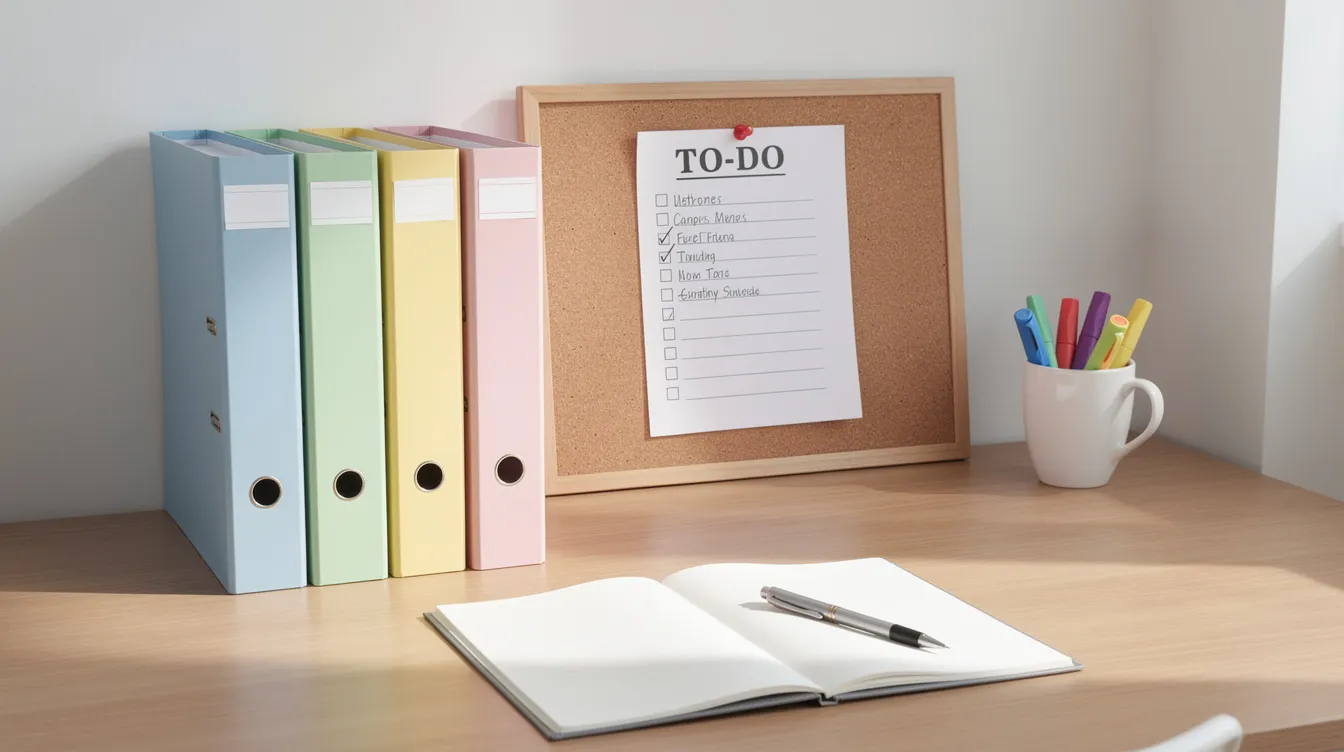
Using visual aids such as colour-coded folders can help children manage their school materials-blue for Maths, green for Science, red for English. Add term-by-term dividers for Science topics. Stick a printed visual checklist in the child’s room for daily packing. Create layout templates for Maths working with clear boxes for “Given, Working, Answer.” Using visual prompts helps children follow through on tasks because the environment does the remembering, not the overloaded brain.
Micro-Step Outlining
Chunking tasks into smaller steps helps children begin work more easily. Teach children to sketch a five-minute mind map before English composition, draft point-form C-E-R answers for Science before writing full sentences, or list three sub-tasks before beginning a large project. This approach supports critical thinking and reduces working memory load simultaneously, and starting with very small steps can help children feel they are achieving progress early.
Building Predictable Routines
A consistent routine supports better organisation and task completion. Establish a fixed nightly “bag-check ritual” at 8.30 pm, a weekly file-sorting slot every Sunday, and a standard way of labelling all worksheets with date, topic, and week (e.g., “Wk 7 2026 – Decimals”). Short-term attention issues often improve with simple changes to routines or the study setup. Reducing background noise improves children’s concentration, so before expecting sustained focus, make sure the basics are covered, like enough sleep, food, hydration, and sensory comfort, then create a distraction-free study area to improve children’s ability to complete assignments. Timed work sessions can make tasks feel more manageable for kids by giving each task a clear beginning and end. Using checklists can help children track their progress effectively.
Process-Based Cognitive Retraining
Programmes that strengthen attention tracking, working memory, visual-spatial scanning, and planning stamina use targeted exercises to develop the underlying capacity-not just the content knowledge; the guiding principles are to build those skills through repeated, structured practice. Explore focus and attention support as an example of attention and learning-readiness work. For families considering structured support that directly retrains executive functioning and independent study habits, a learning intervention offers a process-driven pathway. Improving executive functioning can enhance self-management of schoolwork over time.
Praise and recognition of effort helps motivate children in developing organisational skills. Frame these tools as resources for independence and more free time-not punishment for being “messy.”
Practical Home and School Strategies by Age Group
Organisational expectations must be developmentally realistic. Young children focus on one thing at a time until about age four, and children’s attention spans grow with age and practice.
| Age Group | Key Strategies |
|---|---|
| P1–P3 | One homework folder for all subjects; a visual timetable near the study desk; adult-guided packing using picture cues; very short checklists (“1. Book in bag, 2. File in bag, 3. Pencil case”). Chunking tasks helps children manage overwhelming assignments at this stage. |
| P4–P6 | Multi-file systems by subject; filing by topic and term; breaking exam revision into weekly chunks; simple weekly planners mapping tuition, CCA, and homework. Regular backpack and desk cleanups can prevent clutter buildup and improve organisation. |
| Sec 1–4 | Digital calendar synced with school and tuition times; separate ring binders per subject with index tabs; backward planning for mid-year and end-of-year exams; teaching children how to sort and manage materials so they develop independence. |
Encourage collaboration with teachers-ask about subject-specific filing expectations and share any executive-function systems being used at home. The goal at each stage is to shift a little more responsibility to the child while still scaffolding, so that organisational skill becomes part of everyday life, not just exam-season behaviour.
Conclusion: From Chaos to Structural Confidence
Children’s disorganisation-missed homework, untidy working, lost notes-is usually rooted in trainable cognitive systems, not moral failings. When families understand executive function, working memory, and sequential processing, they can respond with structured support instead of more scolding or more tuition. Effective organisation can reduce stress and improve task management across every subject.
Start small: choose one area-a packing checklist, a new Maths working template, or a Sunday filing routine-and practise it consistently for a few weeks before adding more systems. With patient guidance, process-based interventions, and school-home collaboration, children can gradually develop the organisational frameworks needed to manage complex tasks in school and in later life. The improvement may be gradual, but the confidence it creates is lasting.
FAQ
How do I know if my child’s disorganisation is typical for their age or a sign of deeper difficulty?
Occasional mess and forgotten homework are normal across development. Red flags include persistent disorganisation lasting at least six months, repeated loss of key materials, and inability to follow multi-step instructions even with reminders. To explain the difference, the concern is not mess alone but whether your child can plan, sequence, and carry out school tasks consistently across settings. If teachers notice the same patterns in class and it is affecting marks or self-esteem, consider consulting an educational psychologist or paediatrician who can conduct a proper assessment of attention and executive function profiles. Learning disabilities such as ADHD or dyslexia should be ruled in or out through professional evaluation.
What if my child can organise gaming or hobbies very well but schoolwork is always chaotic?
This is common. Games and hobbies provide built-in structure, instant feedback, and high interest, which reduce cognitive load. Schoolwork demands more self-generated planning. Try borrowing systems from hobbies-progress bars, in-game-style checklists, or reward structures-and apply them to homework routines. This can help bridge the gap and reflect what genuinely works for the child’s brain.
Is it better to force my child to use one specific planner or let them choose their own system?
Start with a simple, parent-guided structure such as a basic weekly planner or school diary. Then gradually invite the child to adapt it-choosing colours, symbols, or deciding between a computer-based tool and paper. Avoid frequent system changes; trial one method for at least three to four weeks before deciding whether to adjust. Ownership builds metacognitive awareness and long-term motivation to stay organized.
How long does it usually take to see improvement in a disorganised child’s work habits?
Superficial changes-slightly neater books, fewer forgotten items-may appear within a few weeks once routines are consistent. Deeper shifts in executive functioning and independent organisation usually take several months of steady practice. Monitor trends across each week rather than expecting daily perfection, and acknowledge visible effort on using checklists, filing, or planning. This reinforces the new neural pathways for organised behaviour.
Can building organisational skills really improve academic results, or is it just about neatness?
Better organisation often leads to higher marks: students attempt more questions, make fewer copying errors, revise more systematically, and present ideas more clearly in compositions and Science answers. These skills also support long-term development beyond exams-time management, planning complex tasks, and structuring communication are foundational abilities for further study, work, and life.
Comments are closed