Key Takeaways
- Independent learning is not a personality trait-it is built by deliberately training executive functions such as planning, working memory, and self-monitoring from about Primary 2 onward.
- Shift away from sitting beside your child every minute. Start with structured routines: clear checklists, 10-minute independent sprints, and systematic work-checking habits this week.
- A supportive learning environment-quiet desk, predictable routine, visible timer-protects your child’s limited working memory and focus stamina so they can actually think.
- When problems are long term and appear across subjects, consider executive function assessment and learning intervention support rather than blaming laziness or piling on more tuition.
- Fewer, higher-quality, process-focused supports produce better outcomes than many overlapping content-heavy classes.
Introduction: Escaping the “Spoon-Feeding” Trap in Singapore Homes
It is 7.45 pm on a Tuesday in 2026. A Primary 5 child sits at the dining table with his MOE homework, two tuition worksheets, and a Science revision paper. His mother perches on the next chair, reading every question aloud, pointing at the key phrase, prompting “What type of heuristic is this?”, erasing his wrong answers, and timing every section. Without her, he stares at the page. With her, he finishes-but she finishes too, exhausted and wondering how he will survive Secondary 1 alone.
This pattern is common across Singapore households, and it builds dependence. The child outsources planning, checking, and time management to an adult instead of developing his own cognitive systems. Task initiation, error detection, and concentration become someone else’s job.
Here is the reframe every parent needs: children learn best when they actively engage in their learning process rather than rely on adult intervention. Independent learning is not something that switches on at twelve. It is a trainable set of brain systems that must be deliberately practised. Fostering independence helps children take ownership of their education-and that ownership is the real gift of childhood.
The goal of parenting during school years is not getting today’s worksheet correct. It is building a brain that can handle Sec 3 workload without constant supervision.
Understanding Executive Functions: The Brain’s Study Control Centre
Executive functions are the brain systems that manage planning, organising, starting, monitoring, and finishing tasks at school and at home. Think of them as the control centre that decides what to pay attention to, what order to do things in, and when to stop and check. Students’ self-regulation skills can be taught as early as elementary school, and research consistently shows that higher levels of self-regulation correlate with better academic performance.
Key components every parent should recognise:
- Task initiation – the ability to begin an assignment without adult prompting. A P4 child who opens her Math workbook and starts question one without being told three times is demonstrating strong task initiation.
- Working memory – holding instructions, steps, or concepts in mind while working on them. Essential for multi-step problem sums and Science open-ended questions.
- Inhibition – resisting the urge to check a phone, call out to a sibling, or rush through without thinking. It keeps the child on task.
- Cognitive flexibility – switching between subjects or approaches when the first strategy fails. Task switching between Math and English homework, for example, requires this skill.
- Self-monitoring – checking one’s own work in real time, catching errors before handing the paper to an adult.
There is an important difference between short term attention lapses-being tired after CCA, losing focus on a Friday evening-and chronic executive function weaknesses that affect long term school performance. A child who forgets instructions occasionally is normal. A child who consistently cannot start work, loses materials weekly, and struggles across subjects despite adequate sleep likely has an underlying executive function gap.
Singapore classroom demands are heavy. Copying multi-step notes, solving heuristics problems, answering Science open-ended questions, and managing multiple subjects in a single evening all depend on working memory and planning. Roughly 10–15% of typical classroom children show working memory deficits severe enough to hinder academic progress. These are not rare cases-they sit in every classroom.
The Cognitive Pillars of Independent Learning
Independent learning rests on three main pillars: planning and initiation, self-monitoring, and memory plus focus stamina. When all three are developing well, a child can sit down, figure out what to do, do it, and check whether it makes sense-without an adult narrating the process.
- Task Initiation & Planning: A P6 child should be able to read a Math revision worksheet, estimate how long it will take, and sequence it against other homework. This means breaking big tasks into smaller steps, deciding which subject to tackle first, and setting a rough time limit for each block. Without this skill, children sit and wait for someone to tell them what to do next.
- Self-Monitoring & Error Detection: This is what it looks like when a child checks their own Science open-ended answers for key marking points before calling a parent. Children should be encouraged to self-assess their work to cultivate self-correction. Incorporating both self-assessment and feedback is essential in self-regulated learning-it moves the child from “Is this correct?” to “Let me check whether I included the key variables and conclusion.”
- Working Memory & Focus Stamina: Holding two or three-step instructions in mind-from problem sums, comprehension questions, or composition plans-separates children who can work independently from those who stop after each question to recheck with an adult. This is the ability to process information, hold it, and act on it without external repetition.
Metacognition positively predicts literacy and math achievement. When children develop the habit of thinking about their own thinking, academic success follows.
Working Memory: Protecting the Child’s Mental “Desk Space”
Working memory is the mental notepad your child uses to keep track of problem-solving steps, composition plans, and Science concepts while working. It is crucial for academic performance across every subject.
Concrete Singapore examples of working memory in action:
- P5 fraction word problems requiring multiple conversions-finding common denominators, converting mixed numbers, then combining results
- P4 composition planning where the child must hold three main events in mind while writing the initial draft of event one
- Sec 1 algebra with several transformation steps: expand, simplify, factorise, substitute-each step depends on remembering the previous one
Cluttered instructions, noisy environments, and multitasking overload working memory. A child toggling between a YouTube tab and a worksheet is not “studying with background music”-they are halving their available mental desk space.
Chunking tasks into smaller steps eases cognitive load. Chunking information eases cognitive load on working memory specifically. Simple home strategies include:
- One page at a time visible on the desk; cover remaining pages
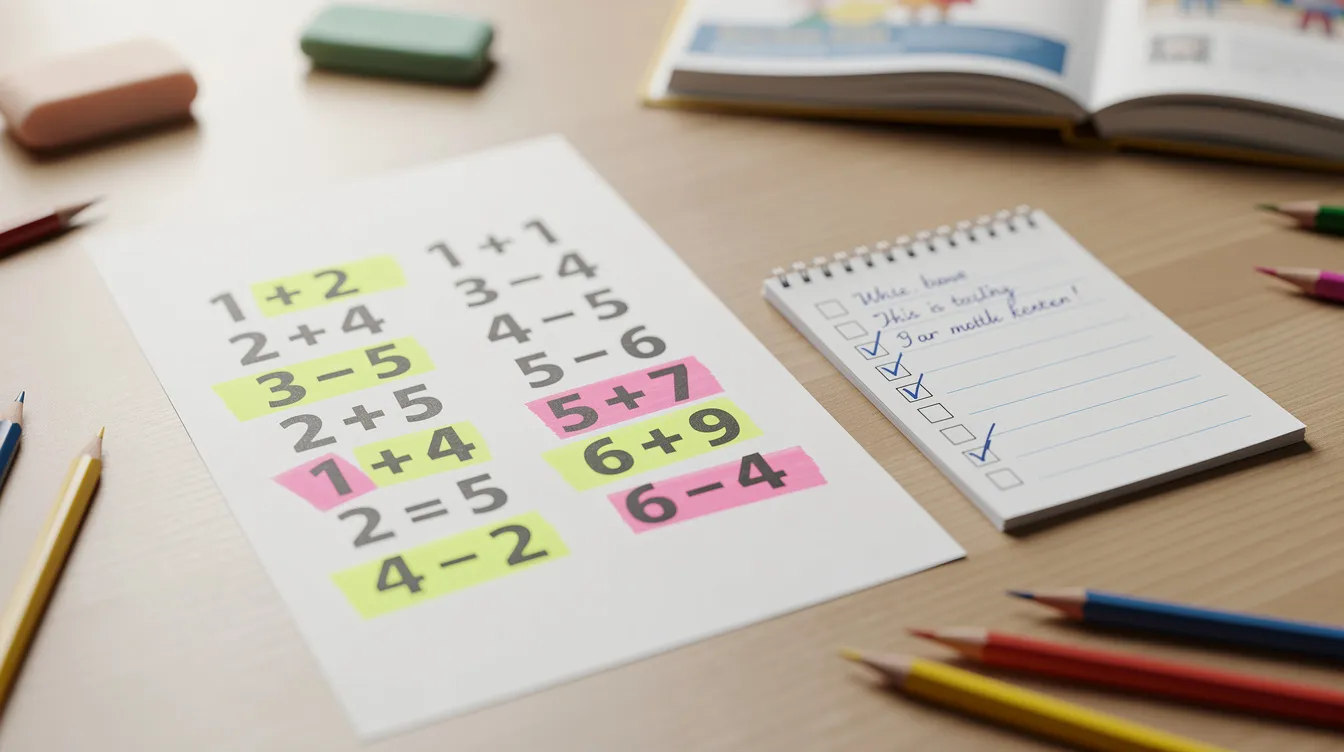
- Highlighters to mark key numbers or important information in a question
- Written “micro-steps” for Science experiment questions so the child can tick each step as they go
- Reducing background noise to enhance concentration during tasks
Repeated, well-structured practice can shift problem-solving steps from working memory into more automatic long term memory. Once a P5 child has practised fraction conversions dozens of times, the procedure becomes semi-automatic, freeing up mental resources for understanding the question’s actual logic. This is how cognitive development compounds over time.
Designing a Home Learning Environment that Builds Autonomy
The physical and sensory learning environment at home either supports or sabotages independence. Every unnecessary distraction places an extra demand on executive functions that could be directed toward the actual task.
Effective learning environments provide children with organised spaces and necessary materials for independence. Concrete setup suggestions:
- A consistent desk used only for study, not meals or play
- Labelled shelves for each subject’s books and files
- A simple daily homework board (whiteboard or printed checklist pinned at eye level)
- Good lighting and reduced visual clutter-remove toys, unrelated devices, and stacked papers
Create a “distraction-light” zone during study sessions (typically 7–9 pm): phones out of reach, no open social media tabs, siblings briefed not to interrupt, and parents modelling quiet work time nearby. Reducing background noise enhances concentration during tasks and protects the child’s limited working memory.
Children benefit from predictable routines that promote self-regulation. A predictable routine-same time, same space-reduces the planning load each day. The child does not need to decide where to sit or when to start; that decision is already made, so their working memory can focus entirely on academic tasks.
Why Extra Tuition Often Inhibits Independent Learning
Many Singapore families rely on tuition from P2 through Sec 4. Content-heavy tuition, however, can unintentionally weaken self-directed skills rather than build them.
Some tuition styles “pre-chew” exam questions. Tutors highlight likely questions, dictate key Science phrases, and walk step-by-step through heuristics so that students learn to wait for guidance instead of planning their own approach. The child improves on familiar exam formats but never learns how to break down an unseen problem independently.
This pattern can mask underlying executive function or processing challenges. Parents then label children as “lazy” when, in reality, they struggle with planning, working memory, or task initiation. Understanding the difference between learning difficulties and laziness is essential before deciding on the next step.
Content-centred tuition focuses on what to write for the next exam, not how to process complex information when faced with an unfamiliar question in two years. It rarely teaches metacognition-questions like “What is this problem actually asking?” or “Which concept applies here?” The result is learners who perform in structured conditions but stall when left alone.
If you have ever wondered why tuition doesn’t help some children, this is often the answer: more worksheets do not automatically create independent learners. A large-scale study of 452 children with low working memory found that despite high compliance with cognitive training, there were no significant academic gains at one or two-year follow-ups when strategy training and classroom integration were absent.
Stage 1 – Externalising Executive Systems with Visual Supports
Stage 1 is suitable for P2–P4 children or older learners who are very dependent. The goal is to move organisation out of the parent’s head and onto paper or simple tools. Effective strategies for fostering independence include scaffolding tasks and encouraging problem solving at each step.
Concrete tools to introduce this week:
- A visual schedule for after-school routines: CCA → snack → homework block 1 → break → homework block 2 → free time. Using visual schedules can help children manage their tasks independently.
- Colour-coded subject checklists (e.g., blue for Math, green for Science) stuck to the desk or wall
- A “pack bag” checklist for each weekday, listing books, files, PE kit, and any project materials
- A visible weekly calendar showing upcoming tests, spelling deadlines, and submission dates
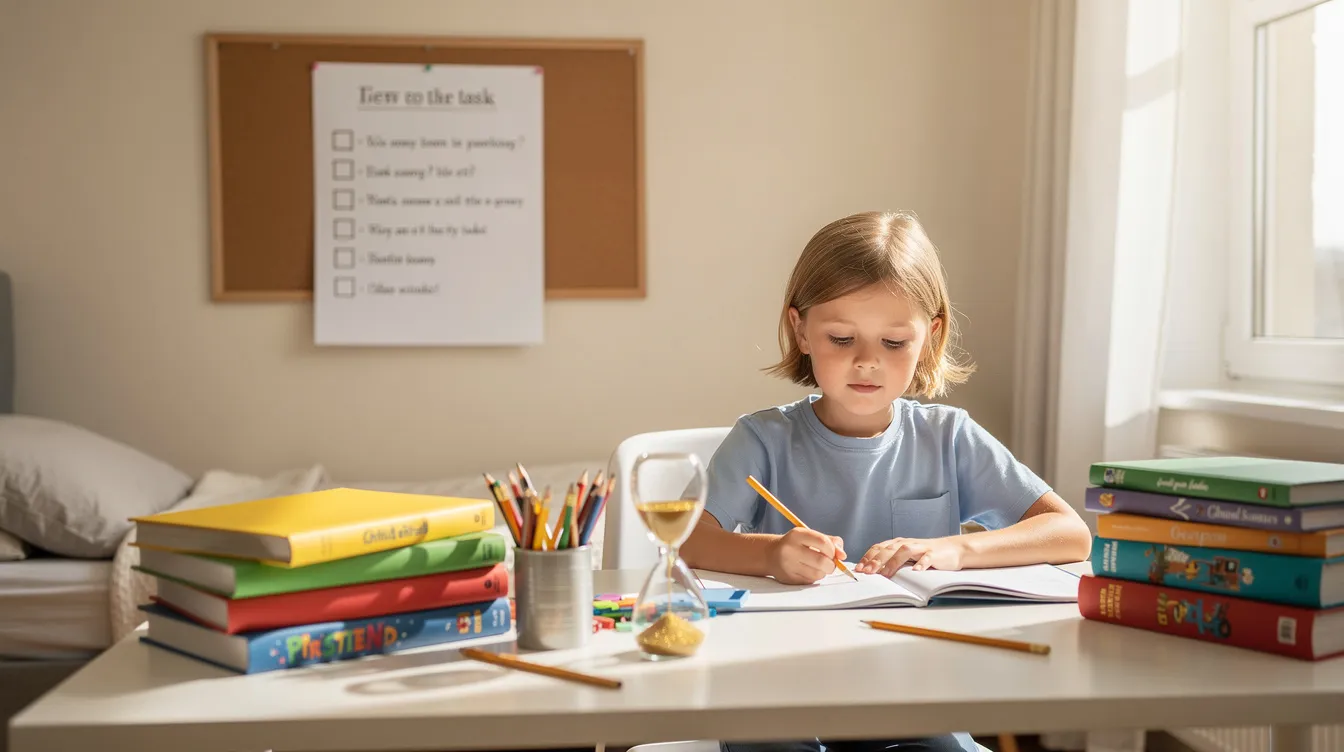
Visual prompts signal next steps to children effectively. When a child looks at the checklist and moves to the next task without asking “What now?”, that is a genuine shift toward independent task completion. Using a timer-a 10-minute sand timer or a digital countdown-helps children manage task effort and reduces arguments about work duration. The child sees time passing rather than hearing a parent nag.
For example, a P3 child’s after-school checklist might read: (1) Put lunchbox in sink, (2) Unpack bag and sort worksheets by subject, (3) Start easiest homework first, (4) Use timer for 10 minutes per subject. This is pinned beside the study desk.
Externalising steps reduces working memory load. The child refers back to the checklist instead of holding the entire sequence in their head-or relying on a parent to repeat it.
Stage 2 – The “10-Minute Independent Sprint” Routine
This is a clear protocol where the child works completely alone for a set block before seeking help.
- For younger children (P2–P4): start with 5–10 minutes
- For older primary (P5–P6): aim for 15–20 minutes
- For lower secondary: build toward 25–30 minutes
How to set it up:
- Agree on rules in advance: the parent will not answer questions during the sprint. The child must underline confusing parts and attempt something for every question.
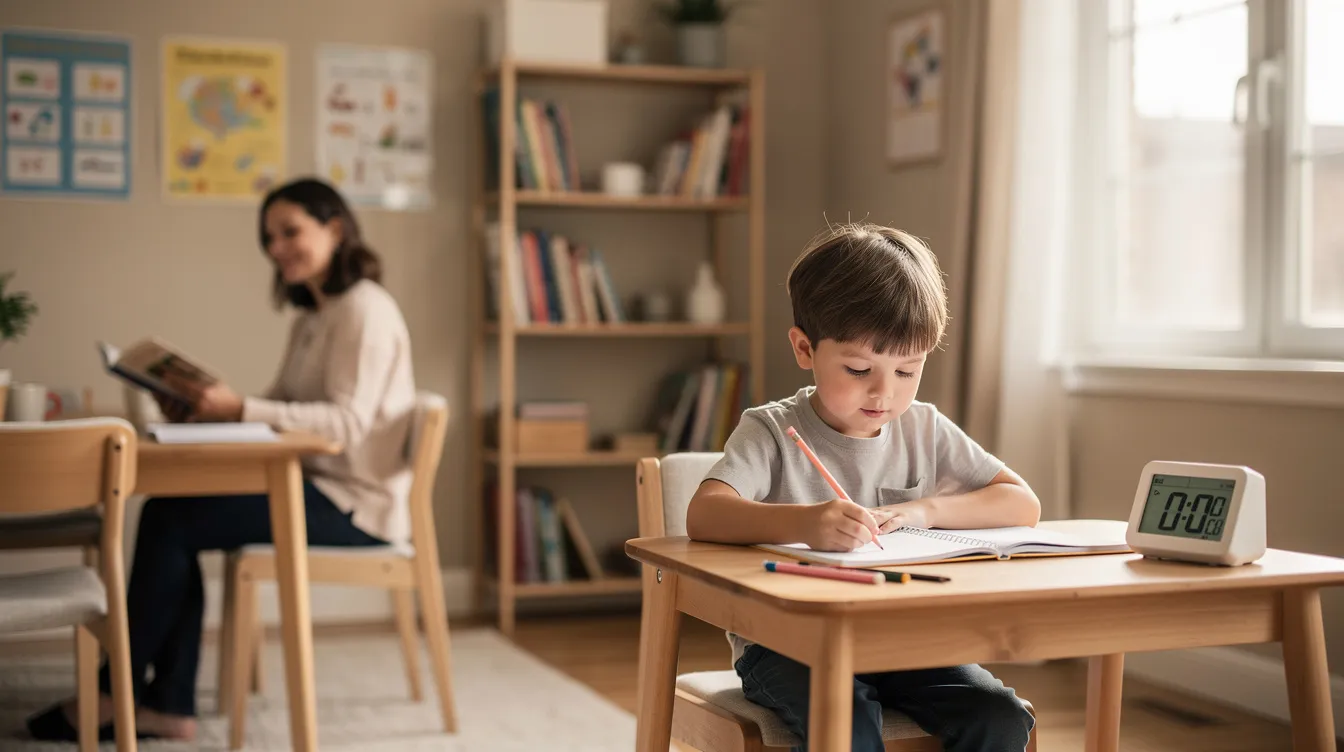
- Set the timer visibly on the desk.
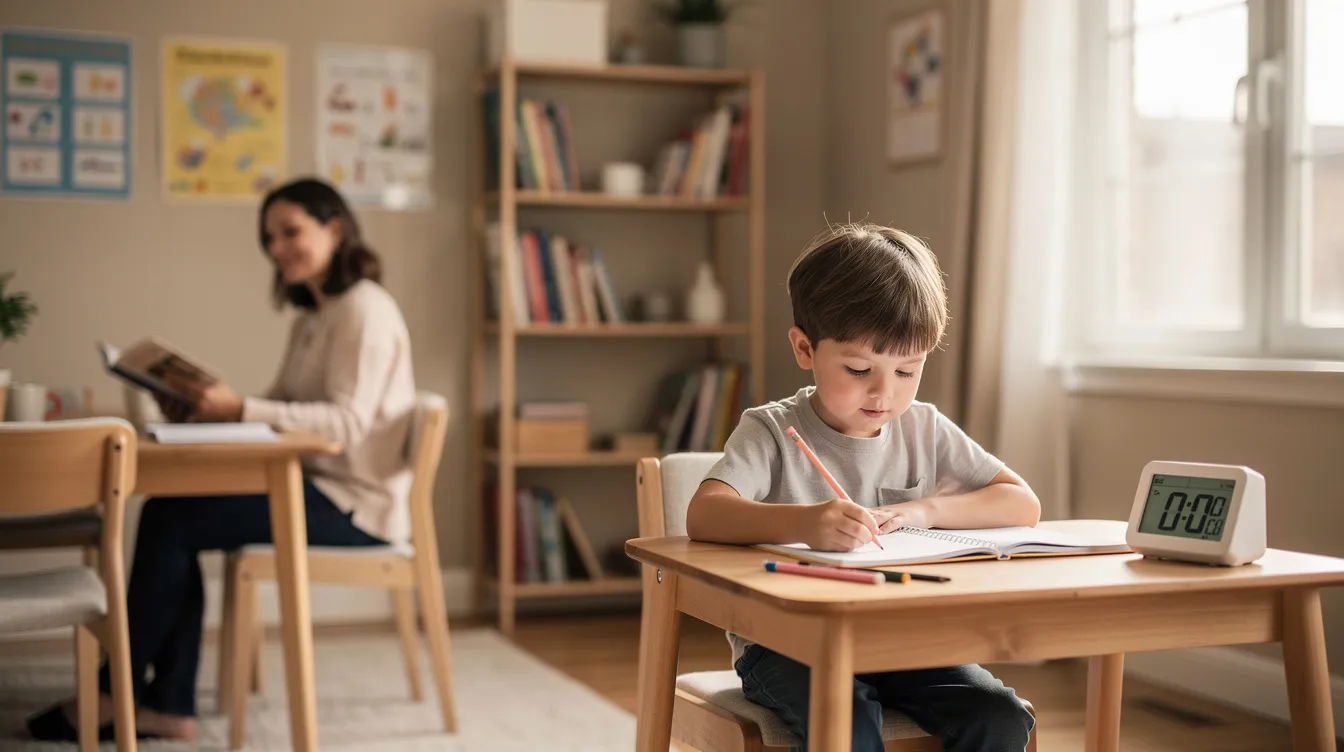
- The parent leaves the room or sits nearby but occupied-reading, replying to emails-rather than actively watching. This reduces performance anxiety and dependence.
- When the timer goes off, the child flags questions they found difficult. The parent reviews only those flagged items.
- Gradually increase sprint duration by 2–3 minutes each week.
Encouraging children to ask for help appropriately enhances collaborative learning-but “appropriately” means after genuine effort, not at the first sign of confusion.
Apply this to real homework: P3 spelling sentences, P4 problem sums, or P6 TYS Science questions. The cognitive aim is building task initiation, tolerating mild confusion, and using working memory to hold instructions without constant adult repetition.
Stage 3 – Shifting from Answers to Metacognitive Prompts
Parents must gradually change the way they respond: from solving the problem to coaching the thinking process. This is where helping children become independent learners shifts from environmental design to direct cognitive training.
Examples of metacognitive questions parents can ask:
- “What is this question really asking?”
- “Which chapter does this remind you of?”
- “Where in your notes or textbook could you check this?”
- “What did you try first, and why didn’t it work?”
Encouraging children to seek information from multiple sources before asking adults promotes resourcefulness. Asking guiding questions can stimulate children’s critical thinking far more effectively than giving the answer outright.
For P5 Science open-ended questions, guide the child to locate key variables and common marking phrases rather than dictating them. Open-ended questions allow children to explore different problem-solving strategies, which is exactly the skill the PSLE rewards.
Use “think-aloud” modelling: briefly verbalise your own planning process (“If I saw this question, I’d first identify the variable being changed, then look at the table for the pattern…”), then ask the child to try. Gradually fade the adult’s voice over two to three weeks.
Self-reflection after tasks can help children identify their progress and areas for improvement. After each study session, ask: “What went well? What would you do differently next time?” These prompts train executive function systems that manage planning, monitoring, and strategy selection. Research combining working memory training with metacognitive strategy instruction showed that the strategy-trained group maintained gains three months later and demonstrated stronger mathematical reasoning than the group that trained working memory alone.
Stage 4 – Process-Based Cognitive Training for Executive Functions
For some children-especially those with persistent struggles from P2 onward across multiple subjects-targeted cognitive training is needed alongside homework routines. This is not about more worksheets. It is about strengthening the underlying systems.
Process-based supports aim to build attention tracking, working memory capacity, and task initiation stamina. If your child has been stuck despite good routines at home, consider focus & attention support designed to address these foundational skills.
A learning intervention in this context means a structured, evidence-based programme that retrains underlying executive functions-planning, flexible thinking, self-monitoring-rather than delivering more drill-and-practice on content.
When should parents consider this step?
- Ongoing meltdowns over homework that persist beyond normal frustration
- Inability to remember multi-step instructions despite weeks of practice
- Major gaps between oral understanding and written output
- Teachers reporting similar patterns in the classroom
Seeking structured intervention is about removing hidden barriers to learning, not labelling your child as incapable. Individual differences matter: some children need more scaffolding than others, and that is a biological reality, not a character flaw.
Building Routines that Separate Short Term Homework and Long Term Learning
There is a crucial difference between “finishing today’s homework fast” and building durable understanding that reduces future workload. Teaching children time management skills can enhance their learning independence across both horizons.
A simple nightly structure:
| Block | Duration | Purpose | Example |
|---|---|---|---|
| Homework | 20–40 min | Complete assigned tasks | MOE worksheets, corrections |
| Consolidation | 10–20 min | Transfer concepts to long term memory | Flashcards, spaced retrieval, quick mind maps |
Establishing independent learning routines can strengthen children’s self-management skills. Self-regulated learners use cognitive strategies like rehearsal and elaboration-reviewing P4 times tables three times a week for five minutes, revisiting P5 Science concepts like photosynthesis through quick diagrams, or practising Sec 1 algebra formulae with spaced repetition rather than last-minute cramming.
Effort regulation is linked to higher literacy achievement. The executive function skills practised through routine include planning, time estimation, and prioritising tasks across days-for example, spreading out a project over a week rather than one night.
Fading Parental Involvement Across Primary and Lower Secondary
Gradual release of responsibility is vital in fostering independence in learning. Here is an age-based roadmap:
| Stage | Age/Level | Parent Role |
|---|---|---|
| High scaffolding | P2–P3 | Shared checklists, reading instructions together, checking every task |
| Partial check-ins | P4–P5 | 10-minute sprints, parent reviews only flagged questions, child packs own bag |
| Independent planning | P6–Sec 2 | Weekly reviews, child leads planning, parent asks clarifying questions only |
What to “fade” each year: first, parents stop holding the pencil or writing answers. Next, they stop reading every instruction aloud. Later, they stop checking every single question daily.
A practical tool: a weekly “handover meeting” on Sundays. The child leads a 10-minute review of the coming week-tests, CCA timings, tuition schedule-while the parent asks clarifying questions rather than dictating the plan. Providing children with meaningful choices during this meeting can increase their ownership of learning.
Fading support should be gradual and planned-not an abrupt withdrawal after PSLE. The child needs time to build and consolidate executive function habits before the demands of Secondary school arrive.
Recognising When Struggle Signals Deeper Executive Function Gaps
Clear warning signs that go beyond normal reluctance:
- Consistent forgetting of instructions despite reminders
- Losing materials weekly
- Inability to start work without repeated prompts across multiple settings
- Huge differences between oral answers and written work
- Meltdown-level distress over homework several times a week
There is a difference between a child choosing not to use skills they have (a motivation or behaviour issue) and a child lacking the skills-planning, working memory, organisation-to meet expectations. A P3 child who can explain a Science concept verbally but writes nothing meaningful on paper may have a processing gap, not an attitude problem.
Long term patterns across home, school, and tuition settings suggest an underlying executive function or learning difficulty rather than a short term mood issue. Parents should collaborate with teachers, school counsellors, or an educational psychologist in Singapore rather than escalating punishment or dramatically increasing tuition load.
Collaborating with Schools and Tuition Centres Without Losing Autonomy
Parents can brief teachers and tutors on home strategies-checklists, 10-minute sprints, metacognitive prompts-so that similar supports are used in class or lessons. Aligned expectations across home, school, and tuition compress the learning curve.
Sample questions to ask your child’s tutor:
- “How do you help my child plan answers on their own?”
- “What metacognitive routines do you teach instead of just giving model answers?”
- “Can you break instructions into numbered steps so my child can follow independently?”
Encourage small, specific classroom adjustments that support executive function: breaking instructions into numbered steps on the whiteboard, or allowing structured use of checklists for forgetful students. When relationships between home and school are aligned, the child’s long term habits stabilise faster.
Supporting Motivation While Raising Expectations for Independence
Heavy academic pressure in Singapore can reduce intrinsic motivation, leading children to depend on adults for constant reassurance or quick answers. The present challenge is to sustain effort while raising the bar for autonomy.
Growth mindset can be fostered by praising effort and the learning process rather than just outcomes. Use specific, effort-focused praise linked to executive functions:
- “I noticed you checked your own answers first-that shows real progress.”
- “You started your Math without my reminder today. That took effort.”
Mistakes should be reframed as opportunities for learning rather than as failures. Normalising mistakes as learning opportunities helps children feel safe when taking risks. Building resilience in children is crucial for their ability to navigate challenges-and resilience grows from experience with manageable difficulty, not from protection against all struggle.
Use small, predictable rewards tied to completing independent sprints or managing a study checklist without prompting: extra reading time, weekend choice activities, or a favourite outing. Positive feedback helps develop executive function skills over time.
For older children, natural consequences-such as going to school with incomplete work occasionally-can help them experience the link between planning and outcomes. Use this calmly and without harsh shaming. Confidence grows when children see that their own effort produces results.
Protecting Brain Energy: Sleep, Devices, and Cognitive Load
Sleep directly affects working memory and executive control. Research-informed guidelines for Singapore school schedules:
- Primary-aged children: 9–11 hours per night
- Adolescents: 8–10 hours per night
Practical device rules that protect the brain’s capacity to concentrate:
- No fast-paced videos in the 60 minutes before homework or bedtime
- Phones kept outside the bedroom on school nights
- App limits activated during exam periods
Research from NUS Medicine and A*STAR has shown that earlier exposure and excessive screen use in young learners is linked to poorer cognitive test performance and weaker executive function metrics.
Chronic overload-late-night tuition, multiple CCA commitments, and weekend tuition marathons-reduces the brain’s capacity to consolidate long term learning and practise independence skills. Meditation and mindfulness improve attention control and can be as simple as five minutes of guided breathing before study time.
Protect at least one “cognitive rest” half-day each week where no academic tasks are scheduled. This is not laziness-it is essential maintenance for emotional regulation and long term self-efficacy.
Conclusion: From Short-Term Scores to Lifelong Self-Efficacy
The aim of education in Singapore is not only a strong PSLE or O-Level score but a learner who can plan, monitor, and drive their own learning into JC, polytechnic, and adult life. Independent learners are better equipped to navigate challenges throughout their lives.
The journey summarised: understand your child’s executive functions, adjust the learning environment, walk through the four stages of autonomy-building, and seek process-based support when needed. The data and evidence from Singapore’s own longitudinal research confirm that parental rule-setting, consistent routines, and enriching time use predict stronger working memory and self-regulation in childhood.
Even if you have been heavily spoon-feeding until P5 or P6, meaningful change is still possible. The brain remains plastic throughout age and adolescence. Three to six months of deliberate practice and consistent routines can produce real, visible development.
Choose one small change to implement in the next week. A nightly independent sprint. A visual checklist. A single metacognitive question after homework. Start there. Build momentum. The system works-but only if you begin.
Frequently Asked Questions
At what age should I start training my child to be an independent learner?
Foundational executive functions develop rapidly between ages 5 and 8 (K2 to P2), making this a good period to introduce simple routines like packing their own bag with a picture checklist or choosing which homework to do first. Real autonomous study habits-self-starting homework, checking work-normally strengthen from about P3 to P5, with further consolidation in Sec 1 and Sec 2. If your child is older, it is not too late. The brain remains plastic throughout adolescence, and structured practice can still build long term independence.
How long will it take for my child to become more independent with homework?
Small improvements-such as starting work with fewer reminders-can appear within two to four weeks if routines are consistent and expectations are clear. Deeper changes, such as planning for tests without prompting and systematically checking work, often require three to six months of practice and alignment between home and school. If you see little or no progress after three to four months of well-implemented strategies, consider an assessment of executive function and learning profiles with a qualified professional.
What if my child refuses to work without me sitting beside them?
Start with very short independent sprints-even three to five minutes-and gradually increase the time only when the child experiences success. Stay nearby but occupied (reading, replying to emails) rather than actively watching, to reduce performance anxiety and dependence. Validate the child’s discomfort (“It feels strange without me here”) while holding the boundary that working independently is a necessary training step. Most children adjust within one to two weeks when the expectation is calm, consistent, and paired with encouragement.
How do I balance school expectations, tuition, and cognitive training without overloading my child?
Map out all weekly commitments on one calendar, then identify at least one weeknight and half a weekend day reserved for rest and unstructured play. If your child is already attending more than three academic sessions per week, consider replacing one lower-yield content tuition session with targeted executive function or learning intervention support. Fewer, higher-quality, process-focused supports often produce better long term outcomes than many overlapping, content-heavy classes. Explore what genuinely moves the needle rather than adding more of the same.
When should I seek professional help for my child’s learning independence?
Clear indicators include persistent difficulty starting tasks, frequent forgetting of instructions, meltdown-level distress over homework several times a week, or stark gaps between oral and written performance lasting more than six months. An educational or clinical psychologist in Singapore can assess working memory, processing speed, attention, and other executive functions to clarify the next steps. Early, targeted support can prevent secondary issues like low self-esteem, avoidance of challenging work, and chronic anxiety about school. The first step is recognising that seeking help is not a failure-it is a strategic decision to remove barriers so your child can finally learn to learn.
Comments are closed