
Key Takeaways
- The classroom paradox is real. An autistic child can recall every detail of the human digestive system yet leave their science worksheet incomplete. This gap between knowledge and output is not laziness – it reflects a mismatch between how autistic students process information and how classrooms deliver it.
- Autism spectrum disorder is a processing difference, not an intelligence deficit. Nearly half of autistic children in Singapore have no intellectual impairment, yet many still underperform relative to their cognitive abilities because classrooms demand rapid sensory filtering, implied social rules, and constant task-switching.
- Five core traits directly affect classroom learning: sensory processing differences, communication challenges, executive functioning deficits, need for predictability, and monotropic focus. Each one interacts with specific classroom demands in measurable ways.
- More tuition and more worksheets often make things worse. Standard drill-and-practice approaches increase processing load without addressing the underlying sensory, executive, or linguistic needs. Targeted cognitive and learning intervention builds the skills that autistic learners actually need.
- A comprehensive cognitive assessment is the clearest starting point. It maps your child’s unique strengths and support needs, enabling evidence-based accommodations and a personalised learning plan instead of guesswork.
Introduction: When Ability and Classroom Performance Don’t Match
Picture a Primary 4 student at a mainstream school in Singapore. He can explain the stages of the human digestive system in remarkable detail – enzymes, organs, sequence. But when his science teacher hands out a worksheet, he stares at the page. Ten minutes later, it is returned marked “incomplete.” His math word problems are blank, not because he cannot calculate, but because the question asks, “What do you think the shopkeeper means?”
This is the classroom processing load in action. In a typical Singapore classroom of 30 to 40 students, children must simultaneously filter sensory input, decode rapid verbal instructions, follow implicit social expectations, organise materials, and produce written output. For autistic learners, these demands compete for cognitive bandwidth in ways that are invisible to most teachers.
Autism spectrum disorder is a neurodevelopmental condition that shapes how a person communicates, processes sensory input, and organises thinking. It is not a measure of intelligence. The way autism affects classroom learning is less about IQ and more about how autistic individuals process language, sensory input, and transitions compared with how classrooms are designed.
This article, written from Cognitive Development Learning Centre’s perspective in Singapore, explores five key autism traits and their direct impact on classroom learning – and what parents can do about it.

Autism Traits in the Classroom: A Quick Overview for Parents
Autism traits can vary widely among individuals, but several domains consistently show up in classroom behaviour and academic performance for children with autism.
- Sensory processing differences: Heightened or reduced sensitivity to sounds, lights, textures, or smells. Approximately 60–70% of autistic individuals have sensory processing differences that affect how they engage with everyday learning.
- Communication challenges: Difficulty with pragmatic language, figurative language, and reading body language. Some autistic children speak in repetitive phrases or scripts, while others may use alternative communication methods like AAC. Many have delays in expressive language skills.
- Executive functioning difficulties: Trouble with planning, organisation, working memory, task initiation, and cognitive flexibility. Children with autism often struggle with executive functioning skills across every school subject.
- Monotropic focus and special interests: Deep, intense attention on specific topics that can drive extraordinary learning – but also create friction during transitions between subjects. Intense special interests may motivate learning but pose transition challenges.
- Need for predictability: Strong reliance on routine, with anxiety triggered by unexpected changes.
Each autistic child has a unique profile. Some autistic students cope well academically but come home exhausted or melt down after school, signalling hidden processing strain. Roughly 60–70% of autistic individuals also have a learning disability, with reading disabilities being the most common learning disability in autistic children. These traits are a different learning profile – not misbehaviour, laziness, or lack of motivation.
Literal and Concrete Information Processing in a High-Language Classroom
Literal, concrete processing is a core autism spectrum trait. Autistic learners tend to interpret information directly, with minimal inference. This strength in factual recall can be remarkable – a child who remembers every date in Singapore history or recites science definitions word-for-word.
But Singapore’s national curriculum is language-rich. When teachers use figurative language, sarcasm, or vague instructions like “Do it nicely” or “Write more details,” autistic children often have difficulty understanding abstract concepts because the success criteria are not explicit. Communication difficulties can hinder understanding social cues and figurative language, turning a comprehension task into a guessing game.
Common local examples:
- P3–P6 English Comprehension questions such as “What do you think the author is trying to say?” require inference that goes beyond what the text literally states.
- PSLE-style math word problems with hidden assumptions (e.g. “You should know this already”) can trigger anxiety or shutdown.
- Ambiguous phrases like “Finish quickly” provide no concrete benchmark.
Information processing styles can affect understanding of main ideas when those ideas are implied rather than stated. Clear and concise language helps autistic students understand instructions. Parents and teachers can support autistic children by providing worked examples, using explicit step-by-step directions, and directly teaching how to decode implied meaning.
Executive Functioning and Monotropic Focus: Why Starting and Finishing Work Is So Hard
Executive functioning covers planning, working memory, task initiation, organisation, and cognitive flexibility. Many autistic children struggle with working memory deficits and have trouble with working memory, meaning they can hold and process less information simultaneously than their peers. Executive functioning deficits include difficulties with planning and organization that show up across every subject.
In a Singapore school, managing multiple exercise books, spelling lists, group projects, and CCA schedules is effectively a full-time executive functioning load. A bright autistic child may know the content thoroughly but fail to start the worksheet, lose the homework diary, or take twenty minutes to switch from Chinese to Maths. Flexibility is a common challenge for children with autism, making these transitions genuinely effortful – not a matter of attitude.
Building on a student’s interests can enhance engagement and motivation. When a task connects to a child’s deep interest, initiation is almost instant. When it does not, the same child may appear “stuck.” This is monotropic focus at work.
Practical supports include breaking tasks into visual steps, using checklists or timers, and pre-teaching transitions between subjects. For structured guidance, explore resources on executive functioning and cognitive flexibility to understand how these skills can be directly strengthened.
Sensory Processing Differences and the Hidden Cost of “Just Sitting in Class”
Sensory processing differences mean that autistic learners may be hypersensitive (overwhelmed by input) or hyposensitive (seeking more input). Research shows that 86% of autistic adolescents score outside the normal range on two or more sensory quadrants, with auditory issues being nearly universal.
Bright lights and loud noises can overwhelm autistic students. In a Singapore classroom, that means fluorescent ceiling lights, echoey assembly halls, scraping chairs, buzzing projectors, and the roar of a crowded canteen can drain cognitive energy before lessons even begin. Sensory overload can cause anxiety and behavioral shutdowns in autistic children – not defiance.
| Classroom Sensory Demand | Child’s Likely Sensory Response |
|---|---|
| Fluorescent lighting on for 6+ hours | Eye strain, headaches, difficulty reading the board |
| Crowded canteen at recess | Overwhelm, refusal to eat, isolation |
| Sudden recess bell or fire drill | Startle response, covering ears, meltdown |
| Fan noise layered over teacher voice | Inability to filter speech from background noise |
| Close physical proximity during group work | Agitation, moving away, or shutting down |
Sensory processing differences can hinder classroom participation because the child’s bandwidth is consumed by managing sensory input rather than learning. Flexible learning environments reduce sensory overload, and environmental modifications can help manage sensory sensitivities.
Practical sensory supports include noise-reducing headphones, access to a quiet corner, and sensory breaks that help autistic children refocus on learning tasks. Collaboration with occupational therapy professionals can guide school-level accommodations.

Social Communication and Pragmatic Language in Group-Based Learning
Many autistic children can speak fluently but still face pragmatic language and social communication challenges that affect how they learn in group settings. Social learning requires understanding facial cues and unwritten rules – skills that are often assumed but rarely taught.
Classroom activities that rely heavily on pragmatic skills include “turn-and-talk” discussions, group projects, oral presentations, and unstructured pair work. Many autistic children struggle with understanding social cues, leading to real misunderstandings:
- Taking a classmate’s joke as genuine criticism
- Missing indirect instructions (“Can someone close the window?” is heard as a question, not a request)
- Not recognising when it is their turn in a fast-moving discussion
Longitudinal research shows that autistic children display steeper declines in pragmatic performance in less structured, conversational contexts compared with more structured tasks. This means group discussions are harder than recall tasks – even when the child knows the content.
These communication challenges impact academic performance: autistic learners may avoid raising their hand, skip clarifying questions, or withdraw from group tasks that contribute to participation marks. Social skills training can improve interactions for autistic students when delivered in structured, supportive settings. Inclusive classrooms improve social competence for autistic students when teachers deliberately scaffold group interactions.
For targeted support, specialised communication and language support can help autistic children build pragmatic language skills, verbal communication confidence, and receptive language skills that transfer to real classroom situations.
Need for Predictability and Routine: How Changes Trigger Academic Shutdown
Reliance on predictability can increase anxiety during schedule changes – and in a Singapore school, changes happen regularly. Relief teachers who alter instructions, last-minute timetable shifts due to school events, fire drills, or sudden transitions from group to individual tasks can trigger cognitive shutdown in autistic children.
Even small changes matter: a different seating arrangement after the June holidays, a new exam format, or an unfamiliar classroom rule can produce meltdowns, withdrawal, or what appears to be oppositional behaviour. Establishing predictable routines helps students focus on learning rather than spending energy anticipating what comes next. Structured environments reduce anxiety for autistic learners.
Academically, unpredictability leads to missed instructions during transitions, test anxiety when paper layouts change, and reluctance to attempt new question types despite adequate content knowledge. Structured routines and predictable routines are not luxuries for autistic students – they are functional supports.
Visual schedules, advance notice of changes, and trial runs of exam formats can protect working memory and help autistic students demonstrate their true academic performance.
From “Behavioural Difficulties” to Processing Differences: Rethinking Classroom Behaviour
When an autistic child tears a worksheet after a time limit is announced, hides under the table at assembly, or argues loudly over “unfair” group roles, these are not acts of deliberate defiance. They are signals of overload in sensory, social, or executive processing.
Reframing common behaviours:
| Observable Behaviour | Likely Processing Reason |
|---|---|
| Tearing a worksheet when timed | Executive functioning overload – cannot plan under pressure |
| Hiding under the table at assembly | Sensory overload from noise, crowd, and unpredictability |
| Arguing over group roles | Difficulty with flexible thinking and unclear social rules |
| Walking out of class mid-lesson | Sensory or emotional regulation threshold reached |
Executive functioning issues can lead to impulsivity and emotional dysregulation, which are then labelled as behavioral difficulties. Traditional disciplinary approaches – or purely reward-and-punishment systems – often worsen anxiety without addressing the root cause.
A neurodiversity-affirming approach focuses on identifying triggers, reducing classroom processing load, and teaching replacement strategies such as requesting a break or asking for clearer instructions. Cognitive Development Learning Centre works with families and schools to translate “behaviour reports” into concrete sensory and learning needs that can be supported.
Why Standard Tuition Often Increases Stress for Autistic Learners
Many parents in Singapore respond to slipping grades by adding more tuition or enrichment classes. This is understandable – academic performance matters, and the instinct to do more feels right.
But typical tuition centres mirror the same classroom demands: rapid verbal explanations, long worksheets, group settings, timed drills, and a focus on output. For autistic children, more hours of the same type of input increases fatigue, reduces motivation, and can lead to school refusal or evening meltdowns.
| Standard Tuition | Cognitive & Learning Intervention |
|---|---|
| Group-based, 10–20 students | 1-to-1 or small groups (2–3 students) |
| Focuses on content drilling | Targets executive functioning, attention, and processing |
| Fast-paced verbal instruction | Slow, explicit, multi-step teaching with visual aids |
| Timed worksheets | Paced practice with sensory-aware scheduling |
| One teaching style for all | Individualized instruction addresses specific needs of autistic students |
Cognitive Development Learning Centre offers a different model: slow and explicit teaching of problem-solving steps, targeted support for attention, working memory, and cognitive flexibility – addressing the skills that underpin academic success rather than just repeating content.
Practical Adjustments at Home and in Class: Reducing the Processing Load
These adjustments can be used as a checklist for children with autism at primary school or secondary level, in mainstream school or SPED settings. Classroom environments must be inclusive, predictable, and responsive to support students with autism effectively.
Visual supports and scaffolding:
- Daily visual timetables for homework sequencing
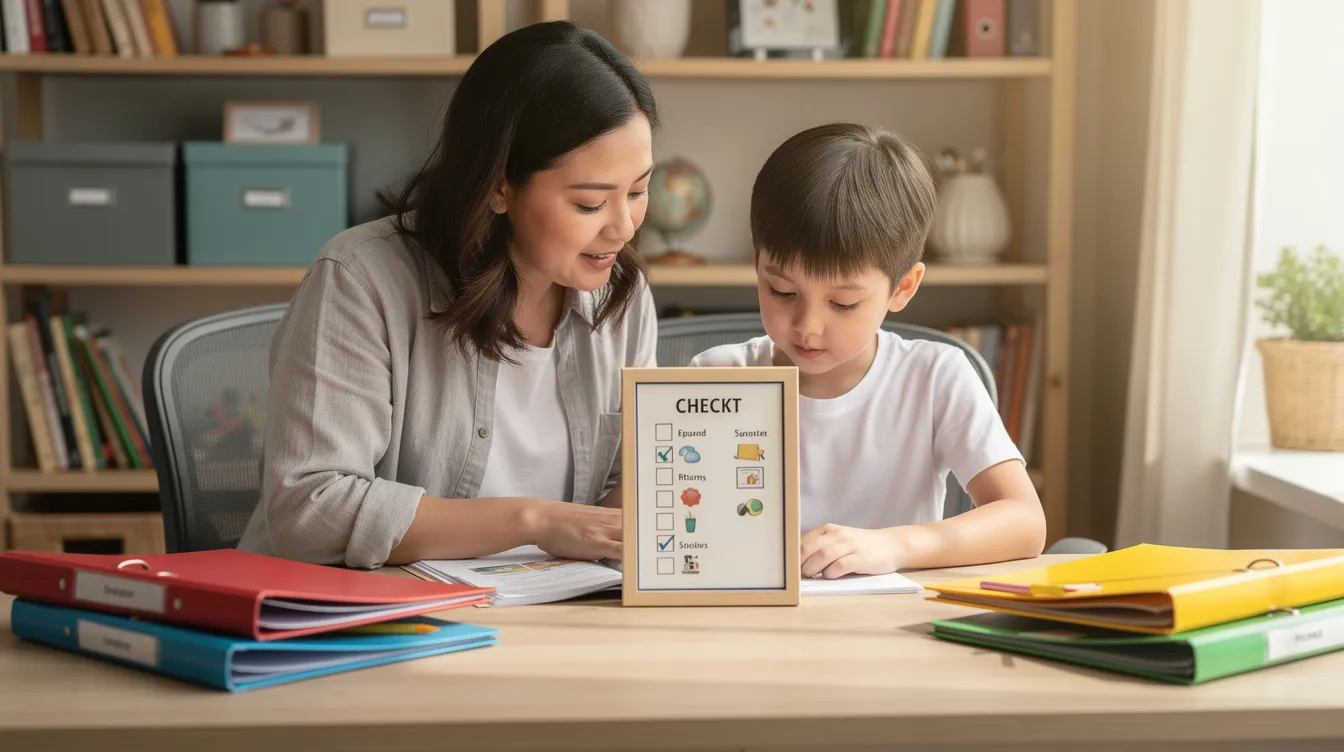
- Step-by-step checklists for tasks like “prepare school bag” or “start composition”
- Graphic organisers for science questions and essay planning
- Visual supports help autistic children understand classroom routines and information better
Explicit instruction:
- Turn vague directions (“Finish the worksheet properly”) into written steps the child can tick off
- Multimodal instructions can aid understanding for autistic learners – combine verbal, written, and visual cues together
Sensory decompression:
- Schedule 10–20 minutes of quiet, screen-free, or calming sensory activity after school before homework
- Sensory accommodations like fidget tools, weighted lap pads, or an optimal learning environment with reduced clutter at the study desk
Collaboration with teachers:
- Share what works at home and request permission for small accommodations (extra time, alternative seating)
- Teachers should collaborate with support staff and include students in decision-making about what helps
- Bring assessment reports to meetings to agree on concrete, tailored supports
Structured Support: Focus, Attention, and Executive Functioning Intervention
Autistic children benefit from direct, structured teaching of cognitive skills rather than simply being told to “concentrate more.” Targeted intervention can strengthen working memory, task initiation, and sustained attention using concrete steps – such as learning to follow two- to three-step instructions or staying with a written task for five extra minutes.
For families navigating focus and attention difficulties, structured intervention provides tools that generic tuition cannot. Similarly, developing executive functioning and cognitive flexibility means children build adaptive skills that transfer across subjects and settings.
Cognitive Development Learning Centre uses individualised, non-ABA approaches combining cognitive training, strategy coaching, and real-school-task practice – including PSLE-style questions and composition planning – to build transferable practical skills. Progress often shows up as smoother morning routines, fewer homework battles, and increased independence in managing school materials, which matter as much as grades.
Role of Cognitive and Psychoeducational Assessment in Understanding the Autistic Learning Profile
A cognitive or psychoeducational assessment uses standardised tests of reasoning, processing speed, memory, and academic skills to map an autistic child’s unique learning profile. It can reveal strengths – strong spatial reasoning, pattern recognition, visual learning ability – alongside specific support needs like slower processing speed or weaker working memory that are invisible in school grades alone.
A large Singapore study of over 2,100 autistic children found that some children with normal overall IQ had verbal IQ scores below 70. This means a child might understand science concepts deeply but perform poorly on language-rich written tasks – a split that only assessment can reveal.
In Singapore, assessment outcomes support applications for Access Arrangements through SEAB – accommodations like extra time, rest breaks, or separate rooms for national exams. Approximately 99% of Access Arrangement applications are approved when properly documented. Individualized Education Plans (IEPs) guide support for autistic students, and flexible assessment methods can accommodate diverse communication styles across different learning styles.
A comprehensive cognitive assessment is not about labelling a child as “weak.” It gives the child, their parents, and their teachers a map of how they learn best within the autism spectrum – moving from guesswork to evidence-based planning.
Partnering With a Specialised Learning Intervention Centre in Singapore
A centre like Cognitive Development Learning Centre fits alongside school and existing therapies such as speech therapy, occupational therapy, or integrated therapy. It focuses specifically on bridging the gap between the child’s ability and classroom demands.
The typical journey:
- Initial consultation with parents to understand the child’s learning profile, school context, and family goals
- Cognitive and educational assessment where needed
- Development of a tailored learning intervention plan targeting executive functioning, sensory-aware study routines, and subject-specific confidence
The centre does not provide ABA, does not rely on rote drilling, and instead emphasises understanding the autistic learning profile, co-regulation, and building flexible problem-solving strategies.
Concrete goals families work on include:
- Preparing for PSLE without burnout
- Building confidence to answer aloud in class and self advocacy skills
- Sustaining attention through a one-hour lesson
- Coping with timetable changes and supporting children through transitions
If you recognise these classroom patterns in your child, early intervention matters – but it is never too late. Contact Cognitive Development Learning Centre for a consultation to explore a supportive learning environment and a balanced education approach tailored to your child’s strengths.

Frequently Asked Questions
Can an autistic child succeed in a mainstream Singapore classroom?
- Many autistic students thrive in mainstream schools when their sensory, communication, and executive functioning needs are met with reasonable accommodations. Inclusive education works best when class size, teacher openness, and availability of Learning Support or School Counsellors align with the child’s needs.
- Monitor both academic progress and emotional wellbeing. Daily meltdowns after school or school refusal are signals that the current placement may need adjustments – not that your child cannot learn.
- Autism influences how a child engages with learning, not whether they can learn. With the right support, diverse learners in mainstream settings can demonstrate genuine academic success.
When should I consider early intervention for my child’s learning?
- Early intervention is helpful as soon as parents or preschool teachers notice persistent differences in communication, play, sensory responses, or the ability to follow group routines – even before primary school. Language development, language skills, and language delays are common early indicators.
- In Singapore, many families begin seeking support between ages 3 and 7, but older primary and secondary students also benefit. Children with attention deficit hyperactivity disorder alongside autism may need support across multiple areas.
- Seek a formal evaluation if you notice a large gap between your child’s understanding (e.g. loves science documentaries, memorises facts) and classroom output (e.g. incomplete worksheets, frequent “careless” mistakes). The learning process is different – not broken.
How does autism affect exam performance, especially for timed tests?
- Slower processing speed, sensory input overload, and anxiety about unclear wording can cause autistic learners to leave questions blank, rush through answers, or misread what is being asked. Autistic children who autism tend to process information more carefully may simply need more time.
- A psychoeducational assessment can document these differences and support applications for accommodations like extra time or rest breaks. Assistive technology and visual cues during revision can also help.
- Practice under exam-like conditions with clear visual time plans, pre-teach question formats, and build regulation routines before and after papers to manage anxiety.
What can I do if my child melts down after school every day?
- After-school meltdowns are a sign that the school day is consuming all of the child’s coping resources. This is not disobedience – it is depletion. The child has been managing sensory overload, social interaction demands, and learning tasks simultaneously for hours.
- Build a predictable decompression routine: quiet time, a snack, a preferred non-demanding activity before any homework begins. This is not a reward – it is a necessary reset.
- Keep a simple diary of triggers (day of week, subjects, events like assembly) and share patterns with teachers and clinicians to adjust the classroom and homework load.
How can I talk to my child’s teacher about autism-related learning difficulties?
- Prepare by listing three to four specific classroom behaviours (e.g. not starting work, covering ears during reading time) and matching them to possible sensory or executive functioning explanations.
- Frame the conversation around collaboration: “Here is what we see at home and what helps – can we try similar supports in class?” This approach is more effective than presenting a list of demands. Supporting communication between home and school is essential.
- Bring any cognitive or psychoeducational assessment reports. These make it easier to agree on concrete accommodations tailored to the child’s learning profile and different learning styles.
Comments are closed