Autism and School Coping Difficulties
Understanding Why Some Children Struggle to Cope in Mainstream School Environments
Many children attend mainstream school every day yet continue to struggle with classroom expectations, routines, transitions, communication, attention, flexibility, emotional regulation, or independent learning. These patterns are commonly observed in children with autism-related learning and developmental profiles.
At Cognitive Development Learning Centre, we provide structured support for children experiencing autism-related learning and school coping difficulties.
What Are School Coping Difficulties?
School coping difficulties refer to challenges managing the learning, behavioural, communication, emotional, and adaptive demands of mainstream school environments. These difficulties are not always caused by intelligence or motivation.
Some children may appear capable academically but still struggle with the daily demands of classroom participation, transitions, communication, flexibility, or independent learning.
Some Children May…
- Understand concepts reasonably well
- Perform adequately in one-to-one settings
- Memorise information successfully
Yet Still Struggle Significantly With…
- Classroom participation and flexible thinking
- Transitions and independent learning
- Inferencing and organisation
- Communication within school settings
- Managing the overall demands of school life
For some children, these patterns may be associated with autism-related learning difficulties, attention and executive functioning challenges, language-processing difficulties, sensory regulation challenges, or broader developmental learning profiles.
Signs a Child May Be Struggling With School Coping
Parents and educators may notice a range of signs that a child is finding it difficult to cope within mainstream school environments. Some children may work extremely hard simply to get through the school day, even when their difficulties are not immediately obvious.
Emotional Signs
- Emotional exhaustion after school
- Increasing anxiety related to school participation
- Shutdowns, withdrawal, or frustration during learning
- Distress during transitions or routine changes
Behavioural Signs
- Avoidance of schoolwork despite ability
- Rigid behaviour affecting classroom participation
- Excessive dependence on adult support
- School avoidance or reluctance
Learning Signs
- Difficulty participating in group learning activities
- Struggles with inferencing or independent thinking
- Difficulty coping with open-ended tasks
- Inconsistent academic performance despite effort
Social Signs
- Becoming overwhelmed in busy classroom environments
- Social misunderstandings affecting classroom learning
- Difficulty understanding classroom expectations
- Struggles with group learning situations
How Autism-Related Learning Difficulties Can Affect School Coping
Mainstream school environments often require children to adapt quickly, process verbal instructions efficiently, interpret implied meaning, participate socially during learning, and cope with sensory and emotional demands simultaneously. Children with autism-related learning difficulties may therefore experience challenges across several key areas.
Classroom Participation
Managing group learning, responding flexibly, and coping with changing classroom expectations throughout the school day
Communication for Learning
Understanding instructions, inferencing, conversational learning, and social communication within academic settings.
Independent Learning
Applying strategies flexibly without relying entirely on repetition or adult prompting across different contexts.
Emotional Regulation
Managing frustration, anxiety, transitions, and stress associated with the ongoing demands of school life.
Social Understanding
Understanding perspectives, group dynamics, classroom interactions, and collaborative learning situations.
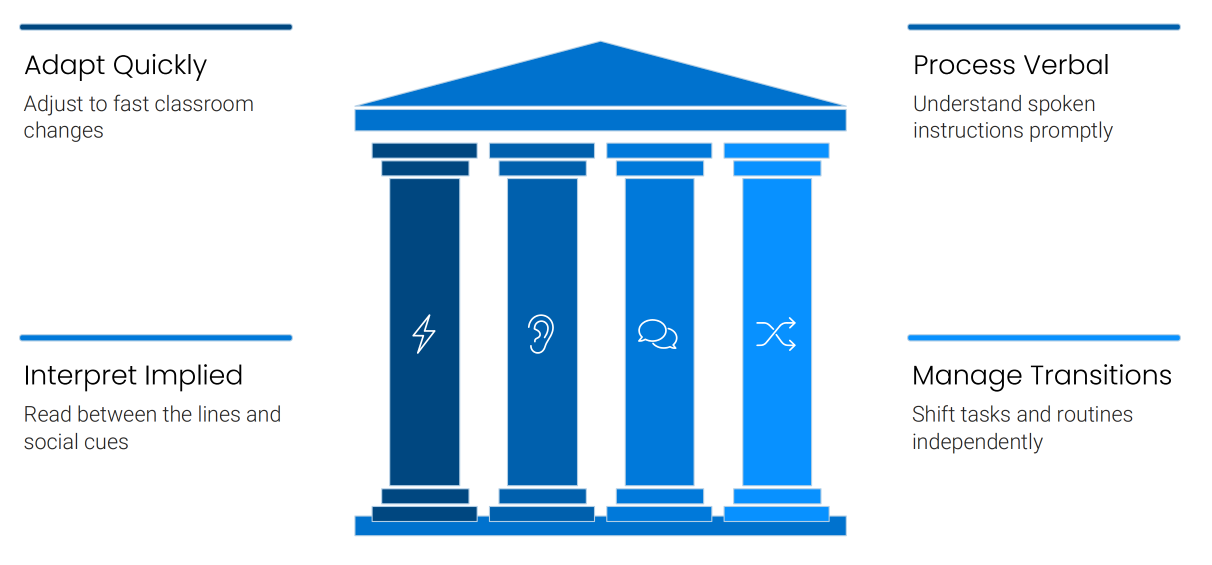
Understanding these interconnected demands helps explain why some children find mainstream school environments so challenging to navigate on a daily basis.
Why Tuition Alone May Not Fully Address School Coping Difficulties
Some parents increase tuition support when a child begins struggling in school. While additional academic practice may sometimes help, some children continue experiencing difficulties because the underlying challenge is not simply academic exposure.
Traditional Tuition Often Focuses On
- Repetition and drilling
- Worksheets and content mastery
- Examination preparation
- Academic subject knowledge
Children With Coping Difficulties May Also Need
- Flexibility and adaptive thinking
- Classroom participation strategies
- Communication for learning support
- Inferencing and comprehension development
- Emotional regulation during learning
- Independent learning strategies
- Support adapting to changing school demands
How Cognitive Supports Children With School Coping Difficulties
At Cognitive Development Learning Centre, our structured cognitive and learning intervention approach focuses on helping children strengthen the processes involved in classroom coping, flexible thinking, inferencing, communication, and independent learning.
We also support children who need help to cope in mainstream school with its broader academic, social, and emotional demands.
🧠 Psychology-Informed
Supported by structured, psychology-informed approaches to learning and mainstream school coping.
🎯 Personalised
Tailored according to each child’s learning profile, strengths, coping patterns, and school-related needs.
🏫 Mainstream School-Oriented
Designed to help children function more effectively within mainstream educational settings.
🌱 Developmentally Focused
Helping children gradually build greater confidence, flexibility, resilience, and learning independence over time.
Our intervention targets the following areas of school coping:
Supporting Children Without Rushing to Labels
Some children who struggle with school coping may already have formal diagnoses, while others may simply experience ongoing learning and classroom difficulties without clear explanations.
At Cognitive, we focus on understanding how each child learns, processes information, copes with school demands, and responds to different learning environments — not on labelling children unnecessarily.
Our Focus
We aim to identify meaningful learning needs and provide structured support that helps children participate more confidently and independently in school over time.
- Understanding each child’s individual learning profile
- Identifying how they process and respond to school demands
- Providing structured, practical intervention
- Building confidence and independence gradually
Who We Support
We work with children across a range of profiles, including those:
- With a formal autism diagnosis
- Awaiting assessment or diagnosis
- Experiencing ongoing school difficulties without a clear label
- Struggling despite appearing capable academically
When Parents Often Seek Support
Parents often approach us when they notice a pattern of difficulties that tuition alone has not resolved. Many families are searching for the middle ground between traditional tuition and highly clinical therapy environments.
School-Related Anxiety
Increasing school-related anxiety, school avoidance behaviours, and emotional distress around attending or participating in school.
Emotional Exhaustion
Emotional exhaustion after school, emotional frustration around learning, and reduced confidence and motivation over time.
Ongoing Struggles Despite Tuition
Classroom participation difficulties and inconsistent performance despite effort and additional academic support.
Difficulties Coping Independently
Difficulties managing mainstream school expectations and coping independently without excessive adult support or prompting.
Our structured cognitive and learning intervention approach aims to support children in practical, school-related ways while preserving emotional confidence, resilience, and long-term learning development.

Book a Learning Profile Consultation
If your child struggles with classroom coping, flexibility, participation, emotional regulation, inferencing, or mainstream school demands, a structured learning profile consultation may help clarify the underlying learning challenges involved.