
When tuition doesn’t bring the progress parents expect
Many parents invest in tuition for their children, often driven by a desire to boost academic performance, address specific learning difficulties, or prepare for important examinations. They commit time, resources, and hope into these additional learning opportunities, expecting to see tangible improvements in grades, understanding, and confidence.
However, for some children, despite consistent effort and financial investment, the expected progress simply doesn’t materialize. Grades may stagnate, motivation might wane, and the underlying learning challenges could persist. This can leave parents puzzled and frustrated, wondering why traditional tuition methods aren’t delivering the desired results.
When tuition works — and when it doesn’t
Tuition is generally effective when a child:
-
Understands instructions easily
-
Can follow explanations without excessive repetition
-
Applies concepts with minimal guidance
-
Has sufficient attention, working memory, and learning stamina
In these situations, tuition reinforces school content and helps consolidate learning.
However, tuition may not be effective when a child:
-
Struggles to understand questions despite repeated explanations
-
Has difficulty sustaining attention or mental effort
-
Finds it hard to organise thoughts or apply concepts independently
-
Becomes anxious, overwhelmed, or avoidant during learning
In such cases, the challenge is often not a lack of teaching, but how the child processes and engages with learning itself.
The difference between content support and learning support
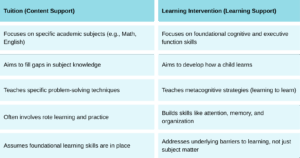
Key foundational skills include:
-
Attention & Focus
-
Working Memory
-
Processing Speed
-
Cognitive Flexibility
-
Self-Regulation
Understanding these differences is crucial for selecting the right type of support for a child’s unique needs.
Ultimately, when tuition doesn’t work, it often points to deeper, underlying challenges in how a child’s brain processes and organises information. Addressing these foundational learning skills through targeted intervention can unlock a child’s full academic potential.
Why some children continue to struggle despite more lessons
As children progress through school, learning demands increase. They are expected to:
-
Read and understand more complex language
-
Apply concepts across subjects such as English, Mathematics, and Science
-
Solve multi-step problems independently
-
Work under time pressure and exam conditions
For children with learning difficulties, these demands can expose challenges in literacy, attention, working memory, conceptual understanding, and learning strategies — even if earlier academic gaps were less obvious.
In these situations, increasing tuition hours may increase pressure without addressing the underlying barriers to learning.
What helps instead: learning intervention
Learning intervention is a specialized approach designed to address the foundational challenges that can impede a child’s ability to learn effectively.
Strengthening Cognitive Skills
Targeted exercises to improve attention, memory, and processing speed.
Developing Executive Functions
Strategies to enhance planning, organization, impulse control, and problem-solving.
Boosting Metacognition
Teaching children how to “learn to learn” through self-monitoring and strategic thinking.
Building Emotional Resilience
Creating a supportive environment to reduce anxiety and foster a positive attitude towards learning.
By understanding each child’s unique cognitive profile, learning intervention can be customised to target specific areas of difficulty, building stronger learning foundations.
What progress usually looks like
Progress in learning intervention is individualised and does not follow a fixed timeline. Rather than focusing on grades alone, progress is observed in how a child engages with learning.
Parents may notice changes such as:
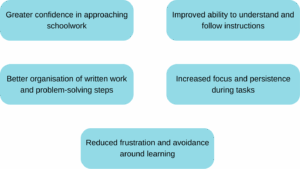
These changes often allow children to benefit more effectively from classroom teaching and academic instruction over time.
When to consider a different approach
Time to pause and reflect?
If your child has been attending tuition consistently but continues to struggle, it may be helpful to pause and reflect on whether the difficulty lies in content or in learning processes.
Learning intervention may be worth considering if your child:
-
Is putting in effort but not making expected progress
-
Appears to understand during lessons but struggles independently
-
Is becoming anxious, fatigued, or resistant to learning
-
Needs support beyond repeated explanations
Moving forward with clarity
Every child learns differently, and some may require alternative learning methods to thrive. When a child struggles to grasp concepts through conventional teaching, it often indicates that their unique learning style has not yet been identified and supported effectively.
At Cognitive Development Learning Centre, we believe that understanding your child’s cognitive profile is the first step towards unlocking their full learning potential. We partner with parents to gain clarity on their child’s learning challenges and collaboratively develop tailored intervention plans to address them.
Next steps

Ready to explore a different approach?
We invite you to reach out for a no-obligation discussion to understand your child’s unique learning needs. Our team is here to listen, answer your questions, and guide you through the process.
Contact details:
Email: info@cognitive.com.sg
Phone: +65 6564 6533 or +65 6635 8104
Website contact form available via Cognitive Development Learning Centre
Comments are closed