Understanding Global Developmental Delay and Learning Difficulties
Global Developmental Delay (GDD) is often identified at a young age. For most parents, the central concern is not understanding the label, but knowing how to help their child cope with learning now, so that future demands do not become overwhelming.
Common Learning Challenges Parents Notice
Parents often notice several recurring learning challenges, including:
- Difficulty retaining concepts even after practice
- Confusion when tasks involve multiple steps
- Loss of previously learned knowledge over time, especially during school holidays
These experiences are common in children with GDD, where development across language, attention, memory, reasoning, and learning readiness progresses at a slower pace. As children grow older, these challenges can affect their ability to cope with structured learning and everyday expectations.
What GDD Looks Like in School and Daily Life
In School Settings
Children with GDD may struggle with understanding, attention, memory, communication, and task completion. Instructions often need to be simplified and repeated, and tasks involving sequencing or organisation can feel overwhelming.
- Difficulty with multi-step instructions and sequencing tasks
- Need for frequent repetition and re-explanation
- Challenges with communication
At Home
Similar patterns may appear in daily routines. Children may forget familiar routines or require frequent prompting to stay on task. Communication difficulties can lead to misunderstandings and frustration.
- Forgetting routines and requiring frequent prompting
- Misunderstandings in communication
- Potential impact on confidence over time
Why Traditional Tuition May Not Be Enough
1
Repetition Focus
Tuition often focuses on repetition and practice without addressing underlying learning processes.
2
Limited Transfer
Learning may not carry over to new contexts despite significant effort and practice time.
3
Short-Lived Gains
Without addressing foundational learning processes, improvements may be temporary and unsustainable.
Important: For children with GDD, difficulties with retention, understanding, and generalisation mean that practice alone may not lead to lasting
progress. Increased practice can result in fatigue or frustration.

How Learning Intervention Makes a Difference
Learning intervention focuses on building foundational learning capacities aligned with developmental readiness. Unlike traditional tuition, this approach addresses the underlying processes that enable learning to occur.
Gradual Introduction
Concepts are introduced gradually and reinforced across contexts to strengthen understanding and retention.
Process-Focused Support
Support addresses learning processes such as attention, memory, understanding instructions, and reasoning.
Sustainable Progress
The goal is steady, sustainable progress rather than rapid academic acceleration.
The Vital Role of Parents and Home Support

Parents play a vital role in helping learning carry over into daily life. They are guided to support learning incrementally, such as reinforcing new words through varied reading contexts to reduce boredom and fatigue.
Parents may also use simple digital tools, including AI-assisted resources, to create personalised reading materials aligned with what the child is learning. The focus is on reinforcing learning processes, not completing academic work for the child.
Incremental Reinforcement
Support learning through varied, engaging contexts that maintain interest and reduce fatigue.
Personalised Materials
Use digital tools to create customised resources that match your child’s interests and level.
Process Over Product
Focus on strengthening learning processes rather than completing assignments.

Is This Support Right for Your Child?
Learning intervention is suitable for children with GDD who experience specific patterns of learning difficulty. Support is guided by developmental readiness rather than age or academic level.
Multiple Developmental Delays
Children experiencing delays across multiple developmental areas including language, attention, and memory.
Retention Difficulties
Children who struggle with retention and require repeated support for concepts to take hold.
Learning Regression
Children who show regression after breaks or when learning routines are interrupted.
Developmental Readiness
Support is tailored to each child’s developmental stage, not their chronological age.
The Learning Intervention Pathway
Support for children with GDD is part of a longer developmental pathway. Early intervention and language support may precede functional academic learning as children grow
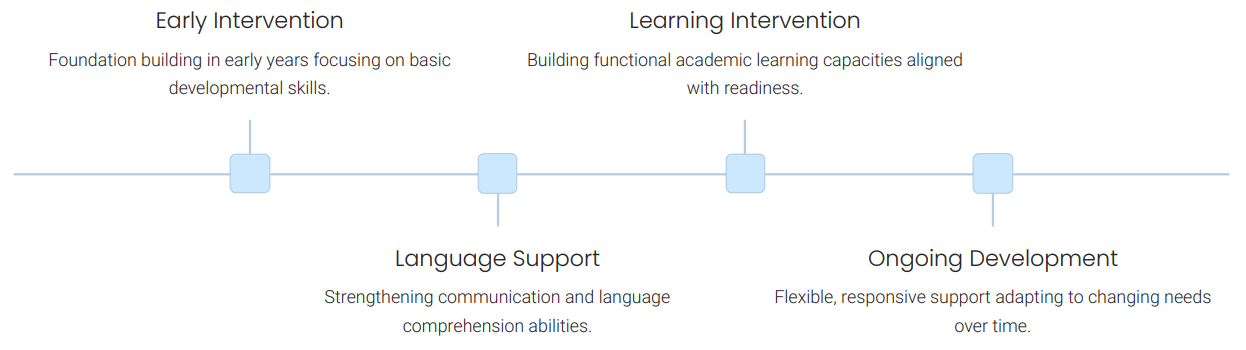
The pathway remains flexible and responsive to changing needs, focusing on coping and independence rather than fixed programmes.
My heading is awesome
Lorem ipsum dolor sit amet, at mei dolore tritani repudiandae. In his nemore temporibus consequuntur, vim ad prima vivendum consetetur. Viderer feugiat at pro, mea aperiam
Improved Understanding
Better comprehension of instructions and concepts with appropriate support and reinforcement.
Better Retention
Enhanced ability to retain information with consistent reinforcement strategies in place.
Reduced Frustration
Decreased frustration levels as learning becomes more accessible and manageable.
Greater Independence
Increased ability to approach tasks with confidence and reduced need for constant support.

Take the Next Step
An initial discussion can help parents clarify their child’s needs and whether learning intervention is appropriate for their situation.
Cognitive Development Learning Centre is a Singapore-based learning intervention centre established in 2009, supporting children through customised, psychology-informed learning intervention.

Established 2009
Over 15 years of specialised experience in learning intervention
Psychology-Informed
Evidence-based approaches grounded in developmental psychology
Customised Support
Individualised programmes tailored to each child’s unique needs