Why Children Struggle to Write Sentences and Paragraphs
Writing requires more than knowing words. It requires organising ideas, selecting appropriate vocabulary and arranging sentences in a clear sequence.
Some children understand what they want to say but struggle to translate those ideas into written sentences. Parents may notice that homework takes much longer than expected or that written answers appear much shorter than what the child could explain verbally.
These challenges are often related to how children organise language, express ideas and process information during learning tasks and commonly seen in children with written expression difficulties.
Understanding why children struggle with sentence and paragraph writing helps parents identify when writing difficulties are related to language organisation.

Why Writing Is More Difficult Than Speaking for Some Children
Writing requires children to manage multiple language processes at the same time, which can make it more demanding than speaking. When writing, children must manage several processes at the same time:
Generating Ideas
Coming up with what to say before a single word is written down.
Organising Thoughts Logically
Arranging ideas in a sequence that makes sense to the reader.
Forming Sentences
Constructing grammatically complete and meaningful sentences.
Selecting Appropriate Words
Choosing vocabulary that accurately conveys the intended meaning.
Maintaining a Clear Flow
Keeping ideas connected and coherent between sentences.
For children who experience language organisation difficulties, managing these processes simultaneously can be overwhelming.

Common Signs of Written Expression Difficulties
These are common patterns that may appear during homework, composition writing and open-ended school tasks. Parents and teachers may observe signs like:
Observable Signs
- Difficulty forming complete sentences
- Writing very short responses even when more explanation is needed
- Ideas appearing disorganised within paragraphs
- Compositions that jump between ideas
- Frequent frustration during writing tasks
What Is Often Misunderstood
These difficulties are often misunderstood as carelessness or lack of effort, when the underlying challenge is organising ideas into written language.
Recognising the true source of the difficulty is the first step towards providing the right support.
How This Affects School Learning
These difficulties often become more noticeable when students are required to explain their answers in writing. In school, many subjects require written explanations. Students are expected to answer open‑ended questions, write summaries and produce compositions.
When sentence construction and idea organisation are difficult, students may:
Lose Marks in Comprehension
Explanations may be incomplete or unclear, resulting in lost marks even when the child understands the content.
Struggle with Composition Writing
Organising a full composition from start to finish becomes a significant challenge.
Find Written Assignments Stressful
The effort required to organise thoughts before writing can make assignments feel overwhelming.
Produce Answers That Don’t Reflect Understanding
Written responses may not fully capture what the child actually knows and understands.
Over time, writing tasks may take significantly longer because the child is working hard to organise thoughts before writing them down.
Supporting the Development of Written Expression
Children can improve their written expression when they learn structured ways to organise ideas before writing. Techniques that help students sequence ideas, plan sentences and structure paragraphs can make writing clearer and less overwhelming.
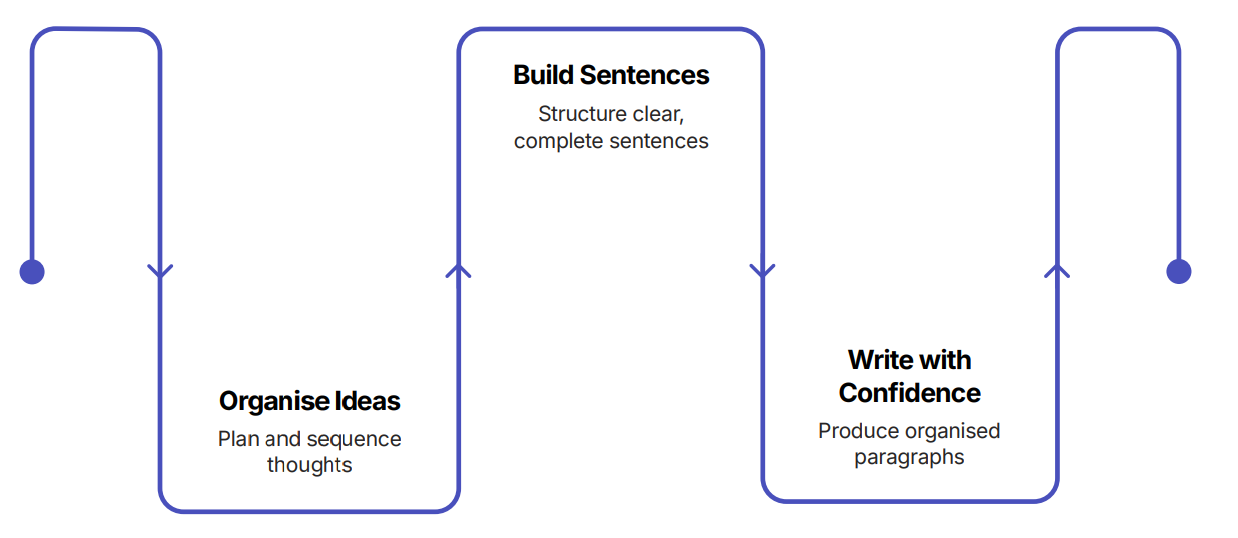
With the right guidance, children can gradually build confidence in expressing ideas through writing.

Related Parent Guides
Explore this related guides to learn more about language and written expression difficulties in children.