Early Signs Your Child May Need Learning Support
Every child learns at a different pace. However, when learning consistently feels harder than it should — despite effort, tuition, or repeated practice — parents may begin to wonder whether something deeper is affecting how their child learns.
When Learning Feels Harder Than It Should
When Effort Does Not Lead to Progress
Some children appear to put in significant effort yet remain confused, slow, or overwhelmed.
Homework takes much longer than expected. Revision requires repeated reminders. Learning feels unusually draining compared to peers.
This guide outlines common patterns parents observe before seeking support, and explains when it may be helpful to look beyond additional practice.
Academic Red Flags
Parents may observe patterns such as:
Memory Challenges
Difficulty remembering concepts taught recently
Repeated Mistakes
Repeated mistakes despite correction
Difficulty Applying Learning in New Situations
Struggles transferring learning across topics
Effort Without Progress
Strong effort but limited improvement in results
Understands During Revision but Struggles in Tests
Understanding during revision but difficulty applying during tests
Behavioural and Emotional Indicators
Learning challenges often appear through behaviour rather than grades alone:

These patterns are also commonly observed in children experiencing autism and school coping difficulties, where the demands of mainstream school environments can cause emotional exhaustion and avoidance.
Patterns That Persist Over Time
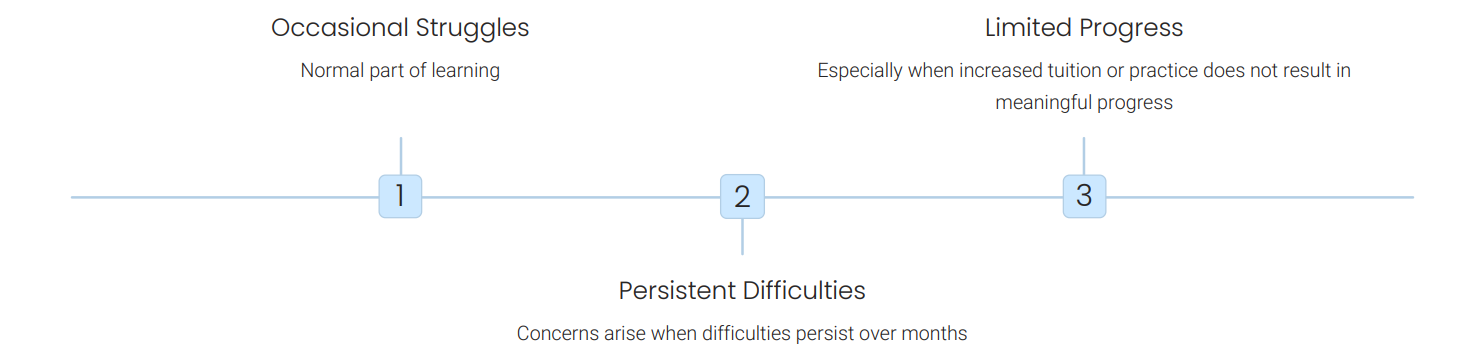
Important Pattern to Watch For: Occasional struggles are normal. Concern arises when difficulties persist over months, especially when increased tuition or practice does not result in meaningful progress.
When Tuition Is Not Enough
When Tuition Works
Tuition is effective when the issue is content-related.

When More Is Needed
However, when a child struggles with retention, application, attention, or exam coping, increasing practice alone may increase pressure, frustration, and self-doubt without improving understanding.
When Should Parents Seek Help?
Parents do not need to wait for failure or a formal diagnosis before seeking guidance. In younger children, assessments may not always provide clear conclusions. However, this should not prevent parents from acting early if concerns persist.
Consider seeking professional input when:
Time Factor
Difficulties persist over several months
Time Factor
Difficulties persist over several months
Time Factor
Difficulties persist over several months
Time Factor
Difficulties persist over several months
Uncertainty
You feel unsure whether the issue is effort, maturity, or a learning difficulty
Early support does not automatically mean long-term intervention. Sometimes it simply means gaining clarity and strengthening small gaps before they widen.
What Early Support Can Do
Early support focuses on understanding how learning is breaking down and strengthening foundational skills such as:

Retention Strategies

Application of Knowledge

Attention Regulation

Confidence
These skills allow children not just to study harder, but to study more effectively and independently.
Our Approach at Cognitive Development Learning Centre
At Cognitive Development Learning Centre, learning intervention equips children with strategies that can be applied consistently at home, in school, and during assessments.
Parents receive structured guidance on how to reinforce these strategies beyond centre-based sessions.

Moving Forward With Clarity
If you are unsure whether your child needs structured support, an initial consultation can provide direction.
The goal is not labelling, but understanding how to support your child effectively and early enough to strengthen foundations before academic demands intensify.
If these signs sound familiar, you may find it helpful to read how to decide what support your child needs, and how language and communication difficulties can affect learning.
Take the First Step
Acting early creates more room to strengthen foundations before academic demands intensify.